Compound identity, metabolite activity and characterization gaps in the TB-500 and BPC-157 evidence base.
Preclinical investigators working with tissue-repair peptides face a recurring problem that rarely appears in supplier literature: the compound described in a cited paper is frequently not the compound in the vial. Sequence fragments, acetylation states, salt forms, and parent proteins circulate through the literature under shared common names, and the resulting attribution errors propagate into experimental design, concentration calculations, and interpretation of null results.
In June 2026, the United States Food and Drug Administration released a set of scientific briefing documents evaluating seven peptides nominated for inclusion on the Section 503A Bulks List, among them TB-500 and BPC-157. Those documents were prepared for a regulatory purpose that has no bearing on research-use supply in Canada. Their scientific content, however, constitutes the most systematic public audit of the published evidence base for these two compounds that currently exists, assembled by pharmaceutical scientists and pharmacology reviewers with access to the full nomination packages.
What the documents show is not simply that human data are sparse, which was already well understood. The more consequential finding for laboratory work is an identity problem. FDA concluded that the peptide commonly sold as TB-500 is not well characterized, that multiple substances with different active moieties are marketed under that single common name, that the three published studies submitted in support of its nomination examined a different molecule, and that in one in vitro assay the parent peptide showed no measurable activity while one of its metabolites did. This article works through those findings and their implications for assay design, reagent qualification, and literature interpretation.
Regulatory Machinery as an Unintended Literature Review
The 503A Bulks List governs which bulk drug substances licensed compounding pharmacies in the United States may legally prepare against a prescription. Whether a substance belongs on it is a question about human-use pharmacy practice, not about laboratory research, and nothing in the process touches research-use classification in either country.
The evaluation methodology, however, produces something useful to researchers. FDA established the criteria in a final rule published February 19, 2019 (84 FR 4696) and applied them across the docket, assessing four factors for each substance: physical and chemical characterization; safety issues raised by use in compounded drug products; available evidence of effectiveness or lack of effectiveness; and historical use in compounding, including references in peer-reviewed medical literature (FDA Briefing Document, Pharmacy Compounding Advisory Committee, July 2026). The first and third criteria require reviewers to catalogue exactly what is known about a compound’s identity and exactly which published studies bear on it.
One procedural detail explains how the documents came to exist at all. The nomination for TB-500 was submitted by Wells Pharmacy Network and subsequently withdrawn, and FDA proceeded to evaluate the substances on its own initiative. The same pattern applied across the docket, with nominations withdrawn for BPC-157, KPV, MOTS-c, Emideltide, Epitalon, and Semax, and the agency electing to present each substance to the advisory committee regardless. The result is a set of independently assembled evaluations rather than industry-authored summaries.
Across all seven compounds and both chemical forms of each, FDA’s stated position going into the July 2026 meeting was that none should be included on the 503A Bulks List.
Compound Identity: One Common Name, Multiple Active Moieties
The characterization section of the TB-500 evaluation is the most directly relevant portion for anyone qualifying a reagent.
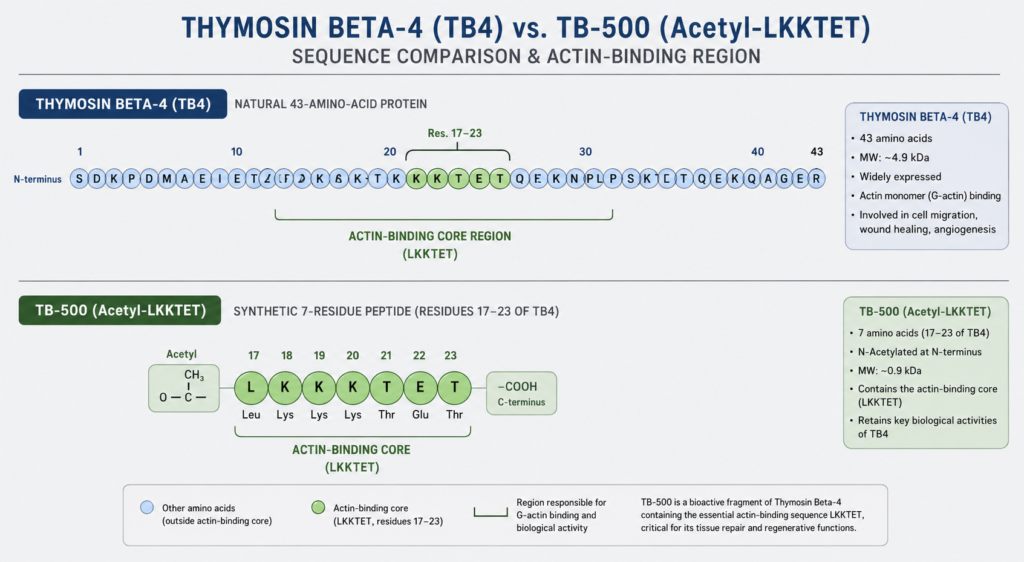
FDA reviewers described TB-500 free base as a seven amino acid synthetic fragment of thymosin beta-4, spanning residues 17 through 23, with an acetyl group on the N-terminal leucine, giving the sequence Ac-Leu-Lys-Lys-Thr-Glu-Thr-Gln-OH (FDA Evaluation of TB-500-Related Bulk Drug Substances, May 2026). The compound sold as TB-500, the actin-binding thymosin beta-4 fragment, therefore corresponds to a defined heptapeptide with a specific N-terminal modification.
The complication is that the name carries no regulatory weight. The evaluation notes that TB-500 is a common name rather than a United States Adopted Name, and that the agency has encountered multiple salts and derivatives, including different active moieties, sold commercially under that same common name. Reviewers concluded that inconsistent naming conventions which do not follow established standards such as INN, IUPAC, or USAN introduce analytical risk, because they make it impossible to determine which substance a particular reference standard is referencing.
The free base and acetate forms are treated throughout the evaluation as distinct substances. The free base carries molecular formula C38H68N10O14 with a molecular weight of 889.01 g/mol, while the acetate form is C38H68N10O14 combined with acetic acid at 949.1 g/mol. That difference of roughly 60 g/mol is approximately 6.8 percent of the free base mass, which propagates directly into any molar concentration derived from a gravimetric measurement.
The evaluation also documents how frequently the two are conflated in commerce. FDA observed that on several suppliers’ websites the CAS number belonging to TB-500 free base, 885340-08-9, is applied to TB-500 acetate. The nomination package itself exhibited the same confusion: the nominated substance was listed as the free base while the accompanying Certificate of Analysis was for the acetate, the CAS number and molecular weight in that CoA corresponded to the acetate rather than the free base, and the molecular formula supplied in the nomination package matched neither form.
For an investigator, the practical consequence is that a vial labelled with a common name and a single CAS number does not by itself establish which molecular species is present or what its formula weight is.
The Attribution Problem: Why Much of the TB-500 Literature Describes a Different Peptide
The effectiveness section produces the finding with the widest reach into everyday literature use.
The nomination cited three published references in support of TB-500, and FDA recorded that all three were studies on thymosin beta-4. The papers in question are Philp and colleagues in Wound Repair and Regeneration (2003), Sosne and colleagues in the FASEB Journal (2010), and Shah and colleagues in Expert Opinion on Biological Therapy (2018). Reviewers further recorded that none of the three discussed a compounded formulation, that no studies were found in which TB-500 was administered to humans, and that available literature was too limited to characterize its historical use.
Thymosin beta-4 is a 43-residue protein. It was originally isolated from calf thymus, was subsequently found to be ubiquitously expressed across cell types and secreted into blood, plasma, saliva, tears, and wound fluid, and has several distinct biological activities that have been attributed to specific amino acid sequences within the peptide. The heptapeptide contains the actin-binding region: the LKKTETQ sequence carries the six-residue LKKTET segment identified as the actin-binding region of thymosin beta-4, and the hypothesis is that by binding globular G-actin but not filamentous F-actin, LKKTETQ may reproduce the G-actin buffering capacity of the parent protein.
A hypothesis about shared mechanism is not the same as demonstrated equivalence, and FDA is explicit that the question remains open. The evaluation states that it remains to be determined whether actin binding contributes to the ability of the heptapeptide to stimulate angiogenesis, induce mast cell degranulation, or promote wound healing.
A second layer of the attribution problem sits inside the fragment literature itself. The principal wound-healing study submitted, Philp and colleagues (2003), applied the non-acetylated heptapeptide LKKTETQ topically to punch wounds in aged mice, alongside thymosin beta-4 and vehicle, and reported increased epidermal closure and collagen content at day seven. The compound sold as TB-500 is N-acetylated.
Caveat on acetylation state: The N-terminal acetyl group is not a trivial label difference. FDA's evaluation notes that because acetylation of peptides and proteins irreversibly alters their charge, hydrophobicity, and size, it can modify their lifespan, folding characteristics, and binding properties, citing Ree and colleagues (2018). Reviewers concluded that the pharmacological profile of the non-acetylated heptapeptide LKKTETQ cannot be directly extrapolated to the N-acetylated heptapeptide TB-500. Any experimental design that treats a citation about LKKTETQ as a citation about TB-500 has crossed a boundary that the reviewing pharmacologists declined to cross.
The layered structure is worth stating plainly, because most secondary sources collapse it: full-length thymosin beta-4, the non-acetylated heptapeptide LKKTETQ, and the N-acetylated heptapeptide TB-500 are three different molecules with three different evidence bases, and the great majority of the accessible literature concerns the first two.
Metabolite Activity and the Parent-Compound Assumption
The most mechanistically interesting item in the document is a single in vitro result that inverts the usual assumption about which species carries activity.
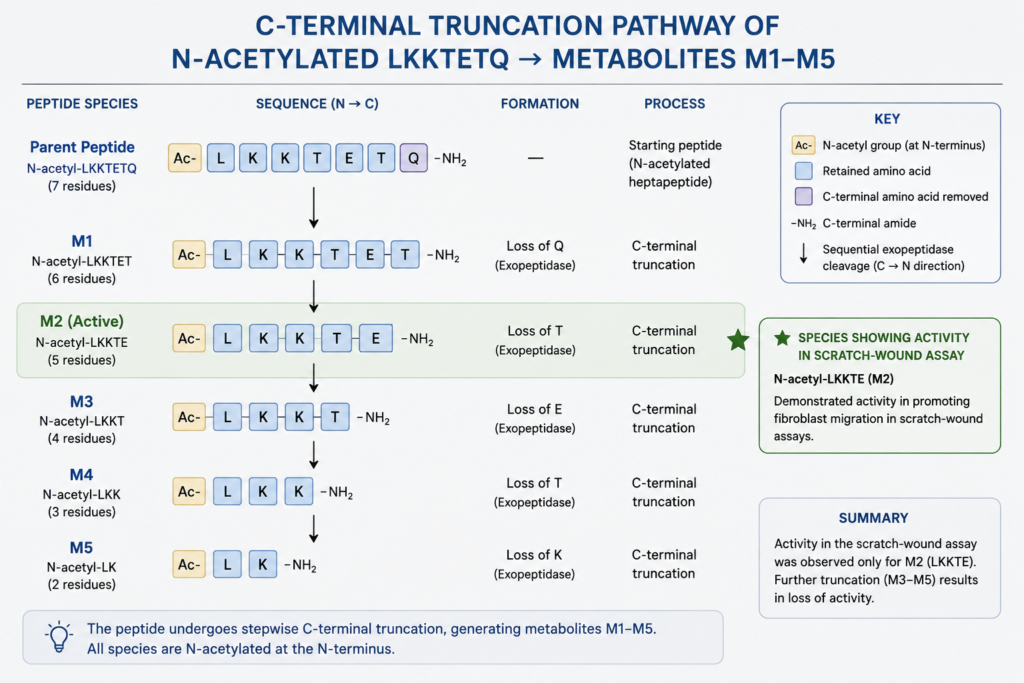
FDA identified a study by Rahaman and colleagues, Journal of Chromatography B, 2024, in which confluent fibroblast cultures received uniform physical scratch wounds and were incubated for eight hours with medium containing TB-500 free base at 50 micrograms per millilitre or with vehicle. Wound closure, quantified by subtracting post-incubation from pre-incubation wound area, was not significantly different between the TB-500 cultures and vehicle. Under the same experimental conditions, the TB-500 metabolite N-acetylated LKKTE at the same concentration produced a small but statistically significant wound closure.
FDA’s stated conclusion is that it remains unknown whether TB-500 free base or acetate could have wound-healing properties in vivo and, if so, whether their pharmacological activity depends on conversion of the TB-500 moiety to a pharmacologically active metabolite. The agency also flags the study’s own limitation, noting that it lacks a concentration-response analysis, so a single concentration in a single assay format cannot settle the question in either direction.
The metabolic pathway is comparatively well mapped, which makes the precursor hypothesis tractable. Ho and colleagues (Journal of Chromatography A, 2012) reported that incubation of TB-500 free base with homogenized equine liver produced a series of C-terminally truncated metabolites through sequential loss of amino acid residues: N-acetylated LKKTET, LKKTE, LKKT, LKK, and LK, designated M1 through M5, alongside additional species generated by enzymatic stereoisomerization of the parent peptide and of M1 and M2. The same truncation series appears in vivo. Plasma drawn from treated horses at approximately two hours contained the parent peptide, its stereoisomer, and metabolites M2 and M5, while urine at approximately six hours contained the parent peptide, its stereoisomer, and M1, M2, M4, and M5.
Metabolite proportions are matrix-dependent in a way that matters for ex vivo work. Across human kidney microsomes, human liver microsomes, pooled human liver cytosol and S9, and human serum, the primary metabolites were the C-truncated M2, M3, M4, and M5 species, with proportions varying by enzymatic system. M2 and M4 predominated in human serum and human kidney microsomes respectively, while M5 was prevalent in human liver microsomes (Zvereva and colleagues, Journal of Proteomics, 2016; Rahaman and colleagues, 2024).
Pharmacokinetic characterization remains incomplete in a way that constrains model selection. In thoroughbred geldings given TB-500 free base subcutaneously, Ho and colleagues (2012) measured plasma concentrations peaking between 60 and 120 minutes and becoming unquantifiable between six and ten hours after treatment, but no intravenous arm was conducted, which precludes establishing absolute bioavailability by the subcutaneous route. FDA identified no pharmacokinetic studies via parenteral routes other than the subcutaneous and intraperitoneal work described, and no acute toxicity, repeat-dose toxicity, genotoxicity, developmental and reproductive toxicity, or carcinogenicity studies of either chemical form.
Prerequisite Condition: What a Standard Certificate of Analysis Does Not Measure
Every conclusion above depends on knowing what is actually in the vial, which is where the evaluation becomes directly operational for laboratory procurement.
For the free base, FDA located no Certificate of Analysis in the nomination package and searched the public domain for a representative example. The document it found reported only appearance, identity by liquid chromatography-mass spectrometry and by HPLC, and peptide purity. Assay, impurities, bacterial endotoxins, and aggregates were neither tested nor controlled. The acetate CoA supplied by the nominator covered appearance, solubility, amino acid composition, water, acetate content, impurities by HPLC with limits of no more than 2.0 percent total and no more than 1.0 percent for the largest single impurity, and purity, but provided no results for identification, assay, aggregates, or bacterial endotoxin.
The gap that draws the most attention from reviewers is aggregation. FDA notes that peptides can be extremely sensitive to formulation, process, and environmental conditions including pH, temperature, concentration, in-process impurities, and excipients, which may lead to aggregation and degradation and to loss of biological activity, citing Zapadka and colleagues (2017). Detecting the various aggregate species may require multiple analytical methods such as size exclusion chromatography or field flow fractionation. The agency observes that peptides with as few as two amino acids have been shown to aggregate.
The following table sets the attributes a purity-focused CoA typically reports against those FDA identified as uncontrolled in the documents it examined.
| Quality attribute | Typical research CoA | What FDA recorded | Relevance to assay interpretation |
| Identity (LCMS, HPLC) | Reported | Present in both examined CoAs | Confirms sequence, does not resolve salt form |
| Peptide purity (%) | Reported | Present in both examined CoAs | Chromatographic purity only |
| Salt form and counterion content | Variable | Acetate content on acetate CoA only | Determines formula weight used for molarity |
| Individual impurity identity | Rarely reported | Not controlled on free base CoA | Truncation and deletion species are structurally similar to target |
| Aggregate content | Rarely reported | Not tested on either CoA | Aggregates alter effective monomer concentration and pharmacology |
| Bacterial endotoxin | Rarely reported | Not tested on either CoA | Confounds any inflammatory or immune endpoint |
| Assay or content (mass of peptide per vial) | Rarely reported | Not tested on either CoA | Net peptide content differs from gross vial mass |
The last row is the one most often overlooked. Chromatographic purity expresses the proportion of peptide-related material that is the target sequence. It says nothing about how much of the vial’s gross mass is peptide at all, the remainder being water, residual counterion, and residual solvent. A vial reported at 99 percent purity may still contain substantially less net peptide than its nominal label mass, and gravimetric reconstitution against the label figure will produce a systematically overstated concentration. Laboratories comparing results across suppliers or batches should treat this as a candidate explanation for shifted dose-response curves before attributing them to biology, and should request the full analytical package rather than the purity figure alone. Peptide Wave publishes its batch verification and analytical documentation standards for this reason.
Storage tolerances are narrower than ambient handling often assumes. Product data reviewed by FDA reports TB-500 free base as stable in powder form for two years at minus 80 degrees Celsius and one year at minus 20 degrees Celsius under sealed, light-protected, nitrogen-blanketed conditions, and once in solvent for six months at minus 80 degrees Celsius and one month at minus 20 degrees Celsius. Reconstituted material is therefore governed by a substantially shorter window than lyophilized stock, which is worth reflecting in how sterile reconstitution diluent volumes and aliquoting schedules are planned at the outset of a study.
BPC-157: A Different Shape of Evidence Gap
The BPC-157 file is not a copy of the TB-500 file. Its characterization position is stronger and its clinical position is weak in a different way.
BPC-157 is a synthetic pentadecapeptide corresponding to a partial sequence of a protein identified in gastric juice, and its sequence and synthesis routes are established. Unlike TB-500, its problem is not primarily that citations describe a different molecule. Drug Topics reported in 2026, reviewing the briefing packages ahead of the meeting, that FDA reviewers identified for BPC-157 a single small trial evaluating ulcerative colitis, available only as a decades-old meeting abstract, and no studies using the oral, subcutaneous, nasal, or transdermal routes proposed by compounders. For KPV, TB-500, and MOTS-c, the same review found no human clinical studies at all supporting the proposed uses (Drug Topics, July 2026).
For preclinical work this distinction has a practical consequence. The mechanistic literature on BPC-157 in cytoprotective and tissue-repair assay models is comparatively deep on the animal and cell-culture side, with proposed pathways centring on nitric oxide signalling and fibroblast migration. What is absent is route-matched human pharmacokinetic data, which means that model selection cannot be anchored to human exposure and must be justified on its own terms.
The two compounds are frequently examined together, and the co-formulated case inherits both problems at once. Any protocol using co-formulated BPC-157 and TB-500 reagents carries the BPC-157 route-data gap and the TB-500 identity and metabolite questions simultaneously, and a null or unexpected result cannot be cleanly assigned to either component without single-agent arms. Investigators evaluating either compound individually will find related reagents grouped under tissue-recovery research compounds.

Frequently Asked Questions
Q1: Why can published thymosin beta-4 results not be applied directly to TB-500?
Direct Answer: Thymosin beta-4 is a 43-residue protein while TB-500 is an N-acetylated seven-residue fragment spanning residues 17 to 23, and FDA’s 2026 evaluation treats them as distinct substances whose pharmacological profiles have not been shown to be interchangeable.
- Sequence scope: The fragment carries the LKKTET actin-binding region but omits the remaining sequences to which other biological activities of the parent protein have been attributed.
- Acetylation state: The principal wound-healing study submitted in support of the nomination used the non-acetylated heptapeptide, and FDA states that its profile cannot be directly extrapolated to the acetylated form.
- Assay implication: A study design justified by parent-protein literature should include a rationale for why fragment behaviour is expected to track it, or should include the parent protein as a comparator arm.
Q2: What does it mean that a TB-500 metabolite showed activity when the parent peptide did not?
Direct Answer: In one scratch-wound fibroblast assay reported by Rahaman and colleagues in 2024, TB-500 free base produced no significant wound closure relative to vehicle while the N-acetylated LKKTE metabolite at the same concentration produced a small significant effect, raising the possibility that the parent peptide acts as a precursor rather than the active species.
- Design consequence: Closed in vitro systems lacking the relevant peptidase activity may not generate the metabolite, so a null result may reflect absent bioconversion rather than absent activity.
- Interpretive limit: The study tested a single concentration without a concentration-response analysis, so it constrains rather than resolves the question.
- Open variables: The pharmacological profile of the remaining truncation metabolites has not been characterized.
Q3: Why does the distinction between free base and acetate forms affect concentration calculations?
Direct Answer: The free base has a formula weight of 889.01 g/mol while the acetate salt has a formula weight of 949.1 g/mol, so using the wrong figure introduces a systematic error of roughly 6.8 percent into any molarity derived from a mass measurement.
- Labelling ambiguity: FDA observed the free base CAS number being applied to acetate material on multiple commercial listings.
- Documentation check: The counterion content line on a Certificate of Analysis, where present, indicates which form is supplied.
- Cross-study comparison: Published concentrations should be checked for which form was used before results are compared across papers.
Q4: What analytical tests are absent from a typical peptide Certificate of Analysis?
Direct Answer: The Certificates of Analysis FDA examined reported identity and chromatographic purity but did not test or control assay content, individual impurity identity, aggregate content, or bacterial endotoxin.
- Aggregates: Aggregation reduces effective monomer concentration and can alter pharmacology, and detection generally requires size exclusion chromatography or field flow fractionation rather than standard HPLC.
- Endotoxin: Uncontrolled endotoxin confounds any inflammatory, immune, or cytokine endpoint independently of the peptide under study.
- Net content: Purity is a ratio among peptide-related species and does not establish how much peptide the vial contains, which is the figure gravimetric reconstitution actually requires.
Q5: How should a preclinical protocol handle a compound whose characterization data are incomplete?
Direct Answer: Incomplete characterization is a documented limitation rather than a disqualification, and the standard response is to specify the exact chemical form and lot in the methods section, retain the analytical documentation, and design controls capable of distinguishing reagent-related artefacts from biological effects.
- Vehicle and lot controls: Running vehicle alongside a second lot of the same compound separates batch-specific artefacts from compound effects.
- Independent verification: Where an endpoint is sensitive to impurity or aggregate load, independent confirmation of identity and purity is preferable to relying on a supplied purity figure alone.
- Reporting practice: Recording the salt form, formula weight used, lot number, and reconstitution date makes a null result interpretable by other groups rather than ambiguous.

What the Documents Change for Preclinical Reagent Selection
The FDA briefing documents were produced to answer a question about United States compounding pharmacy practice, and on that question they have no bearing on laboratory research in Canada. Their value to preclinical investigators is incidental and substantial: a set of trained reviewers worked through the primary literature for these compounds and recorded, in public, precisely where the chain from published finding to vial contents breaks.
For TB-500, the break is at compound identity. The accessible literature is overwhelmingly about full-length thymosin beta-4 or the non-acetylated heptapeptide, the N-acetylated heptapeptide actually supplied has a thin evidence base of its own, one in vitro assay suggests the parent may be inactive while a metabolite is not, and the analytical documentation that normally accompanies the reagent does not measure aggregation, endotoxin, or net content. For BPC-157, the break is at route-matched human exposure data rather than at identity, with a mechanistic animal and cell-culture literature that is comparatively developed and a single decades-old clinical abstract behind it.
The selection rule that follows is straightforward. Studies asking whether the actin-binding domain is sufficient to reproduce a thymosin beta-4 phenotype should include the parent protein as a comparator rather than assuming equivalence, and should state the acetylation state and salt form explicitly. Studies using closed in vitro systems should treat absent bioconversion as a live alternative explanation for a null TB-500 result before concluding the compound is inactive. Studies with inflammatory, immune, or proliferative endpoints should obtain endotoxin and aggregate data or accept that those variables are uncontrolled. And any protocol combining the two compounds should retain single-agent arms, because neither compound’s evidence base is currently strong enough to carry interpretation of the other’s contribution.
Investigators working in Canada should also note that neither compound is authorized by Health Canada for any therapeutic indication. The agency issued a public advisory on April 9, 2026 concerning unauthorized injectable peptide products sold online, stating that research-use labelling does not make such products legal or exempt from regulatory requirements, and advising against consumer purchase or use. The material discussed throughout this article is supplied for laboratory research and in vitro work only.
This article is provided for scientific reference in preclinical and in vitro research contexts. It does not describe or recommend any use in humans or animals. Compounds discussed are not approved by Health Canada for any therapeutic indication.
Ready to Advance Your Research?
Browse our catalog of verified research peptides, sourced and shipped exclusively within Canada. COAs available on request.
Disclaimer: All Peptide Wave products are intended strictly for laboratory research use only. Not approved for, nor intended for, human or veterinary consumption.