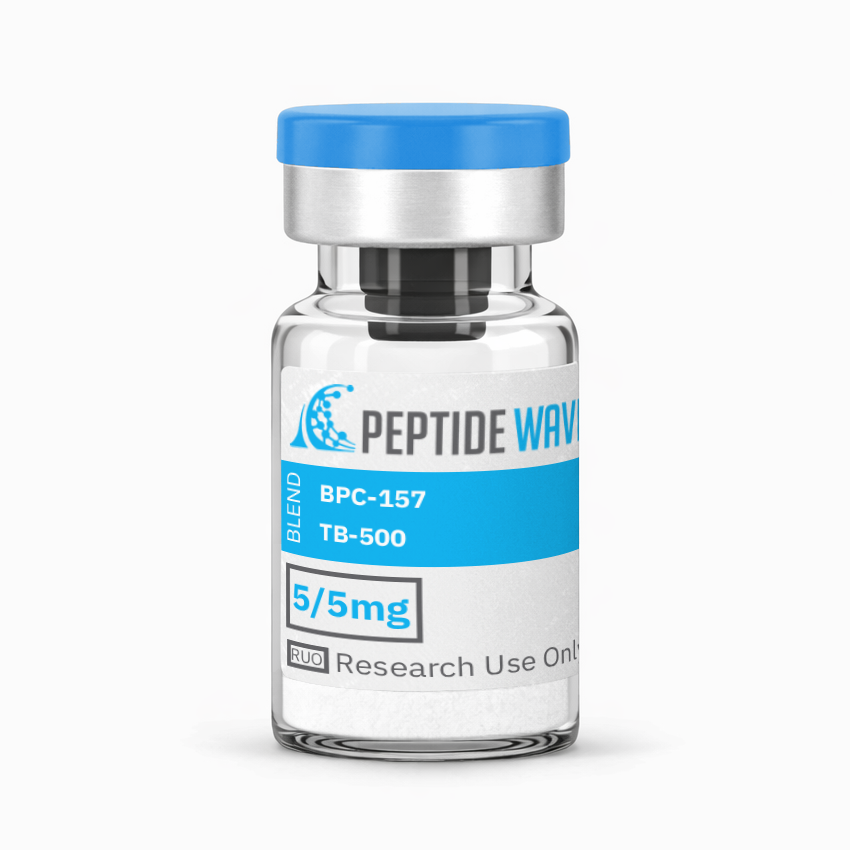
BPC-157 + TB-500 (TB4) Blend
(BPC-157 + Thymosin Beta-4 combined — not a single molecule)
| Property | BPC-157 | TB-500 / TB4 |
|---|---|---|
| CAS # | 137525-51-0 | 77591-33-4 |
| Molecular Formula | C₆₂H₉₈N₁₆O₂₂ | C₂₁₂H₃₅₀N₅₆O₇₈S |
| Molecular Weight | 1,419.54 g/mol | ~4,921 g/mol |
| Amino Acid Sequence | Gly-Glu-Pro-Pro-Pro-Gly-Lys-Pro-Ala-Asp-Asp-Ala-Gly-Leu-Val | Ac-Ser-Asp-Lys-Pro-Asp-Met-Ala-Glu-Ile-Glu-Lys-Phe-Asp-Lys-Ser-Lys-Leu-Lys-Lys-Thr-Glu-Thr-Gln-Glu-Lys-Asn-Pro-Leu-Pro-Ser-Lys-Glu-Thr-Ile-Glu-Gln-Glu-Lys-Gln-Ala-Gly-Glu-Ser (43 AAs) |
| Chain Length | 15 amino acids | 43 amino acids |
Note: BPC + TB4 is a compounded blend of two separate peptides, not a single molecule. It has no single CAS number or molecular formula. The values above reflect each individual component. Blends are typically supplied in a fixed ratio (commonly 1:1 by mass) and reconstituted together.
BPC-157 + TB-500: The “Wolverine Stack”
What Is the Wolverine Stack?
The nickname “Wolverine Stack” refers to the combination of BPC-157 and TB-500 — two peptides each researched for their regenerative and healing properties. Used together, they are thought to complement each other: BPC-157 targeting localized tissue and gut repair, while TB-500 provides systemic, body-wide recovery and flexibility support. The name invokes the Marvel character’s near-instant healing ability.
Why Stack Them?
Both peptides support healing and recovery, but BPC-157 is more focused on gut health and tendon repair, while TB-500 is better for muscle recovery, flexibility, and reducing inflammation. Many people use them together for enhanced healing effects. DrugBank The combination is thought to cover more tissue types and healing pathways simultaneously — BPC-157 working more locally, TB-500 acting more systemically.
BPC-157 mechanism of action
BPC-157 works through several interconnected biological pathways that promote healing and tissue repair. The primary way it promotes healing is by activating the VEGFR2 (Vascular Endothelial Growth Factor Receptor 2) pathway. When BPC-157 binds to VEGFR2 receptors on endothelial cells, it triggers a cascade of events — the receptor becomes phosphorylated, activating it like flipping a switch. ChemicalBook
The key signaling pathways modulated by BPC-157 include:
1. VEGFR2 → Akt → eNOS (Angiogenesis axis): This pathway increases nitric oxide (NO) production, which is essential for endothelial proliferation, vessel dilation, and new capillary formation — particularly beneficial in ischemic or poorly vascularized musculoskeletal tissues. BPC-157 also stabilizes existing vascular structures and modulates vascular tone via NO-mediated vasodilation, safeguarding tissues against ischemic damage during repair processes. Sigma-Aldrich
2. ERK1/2 (Cell proliferation): The extracellular signal-regulated kinase pathway controls cell division and survival. When tissues are damaged, new cells must divide to replace dead or injured ones, and ERK1/2 activation promotes this cell multiplication. ChemicalBook
3. FAK-Paxillin (Cell migration): Focal adhesion kinase (FAK)-paxillin complexes are activated, which help cells migrate and attach to surfaces — crucial for wound healing because cells need to move into damaged areas and anchor themselves to begin rebuilding tissue. ChemicalBook
4. Growth hormone receptor upregulation: BPC-157 dose- and time-dependently increases the expression of growth hormone receptor in tendon fibroblasts at both the mRNA and protein levels. In combination with growth hormone, this enhances cell proliferation and activates JAK-2, the downstream signaling pathway of the growth hormone receptor. Wikipedia
5. Anti-inflammatory pathway suppression: BPC-157 reduces inflammatory cytokines including IL-6 and TNF-α, while downregulating COX-2 and myeloperoxidase (MPO). PubChem
6. Cytoprotection and oxidative stress: BPC-157 enhances eNOS activity through Src kinase-caveolin-1 signaling, upregulating endogenous antioxidants including heme oxygenase-1 (HO-1), thus reducing oxidative stress, preventing mitochondrial dysfunction, and limiting apoptosis. Sigma-Aldrich
7. Neurotransmitter modulation: BPC-157 has demonstrated neuroprotective properties and documented effects on neurotransmitter systems, particularly serotonergic and dopaminergic pathways. ChemicalBook
TB-500 (Thymosin Beta-4) mechanism of action
TB-500 operates from a fundamentally different starting point — the cytoskeleton itself.
1. G-actin sequestration (primary mechanism): TB-500’s best-defined role is actin sequestration. Each molecule binds one G-actin monomer, preventing premature filament assembly and maintaining an intracellular pool of actin ready for rapid polymerization. This balancing act enables cells to reorganize their cytoskeleton during migration, division, and shape changes. PeptideDeck
2. The LKKTETQ active domain: The G-actin binding domain — specifically the amino acid sequence LKKTETQ — is considered the functional core that drives much of TB4’s biological activity. TB-500 is a synthetic derivative corresponding to this active region (residues 17–23) of the full Thymosin Beta-4 molecule. Oasishealthandmedicine
3. ILK signaling cascade: Beyond direct actin sequestration, TB-500’s effects on cytoskeletal dynamics trigger downstream signaling cascades including ILK (Integrin-Linked Kinase) activation — a critical effector mediating cell survival, migration, and differentiation signals — along with NF-κB pathway modulation influencing inflammatory gene expression, and HIF-1α stabilization contributing to hypoxia-adaptive responses during tissue repair. NYMD
4. Pro-angiogenic activity via VEGF upregulation: One of TB-500’s most clinically significant properties in research models is its potent pro-angiogenic activity. Independent of its actin-binding function, TB-500 promotes angiogenesis through direct upregulation of VEGF expression and enhancement of endothelial cell migration. NYMD Notably, this is a different mechanism than BPC-157’s VEGFR2 receptor activation.
5. Cell motility and wound closure: TB-500 stimulates keratinocyte migration two to three fold over controls at concentrations as low as 10 picograms, highlighting its potent effects on cell motility — particularly relevant in wound healing contexts where rapid cell movement into damaged areas accelerates tissue closure. Paragonsportsmedicine
6. Cardiac progenitor cell activation: Research has documented Thymosin Beta-4’s ability to activate dormant cardiac progenitor cells in the adult heart, promoting their migration into infarcted tissue — a potential mechanism for partial cardiac regeneration that the adult heart normally lacks. NYMD
How they complement each other
TB-500 and BPC-157 are frequently studied together in tissue repair research because they operate through complementary but mechanistically distinct pathways. TB-500 primarily functions through actin regulation, cellular migration, and pro-angiogenic signaling via VEGF upregulation. BPC-157 primarily operates through nitric oxide pathways and growth hormone receptor interactions. NYMD
The synergy breaks down into four key dimensions:
1. Angiogenesis via two independent routes. Both peptides are pro-angiogenic, but through different mechanisms. BPC-157 activates the VEGFR2 receptor directly on endothelial cells, while TB-500 independently upregulates VEGF expression upstream. Together they stimulate new blood vessel formation from both ends of the same signaling chain — receptor activation and ligand production simultaneously.
2. Complementary tissue specificity. BPC-157 has particularly robust effects in gastrointestinal, musculoskeletal, and vascular pathologies, while TB-500 shows particularly strong efficacy in cardiac, neural, and dermal tissues. Paragonsportsmedicine Blended together, the two peptides cover a broader anatomical range than either does alone.
3. Structural repair vs. vascular scaffolding. TB-500 excels at getting cells moving — by maintaining an intracellular pool of actin ready for rapid polymerization, it enables cells to reorganize their cytoskeleton during migration, division, and wound closure. PeptideDeck BPC-157 then accelerates the vascular infrastructure those migrating cells need to survive, via nitric oxide-mediated vasodilation and vessel stabilization.
4. Anti-inflammatory convergence via distinct pathways. TB-500 dampens inflammation through NF-κB modulation, while BPC-157 suppresses cytokines (IL-6, TNF-α) and COX-2. They arrive at the same anti-inflammatory outcome through different molecular routes, providing broader and more durable resolution of the inflammatory phase of healing.
![TB-500 [TB4] (10mg)](https://peptidewave.com/wp-content/uploads/2026/01/wavetides-peptide-wave-best-peptides-in-canada-TB-500-Thymosin-Beta-4-43aa-10mg-300x300.png)
Reviews
There are no reviews yet.