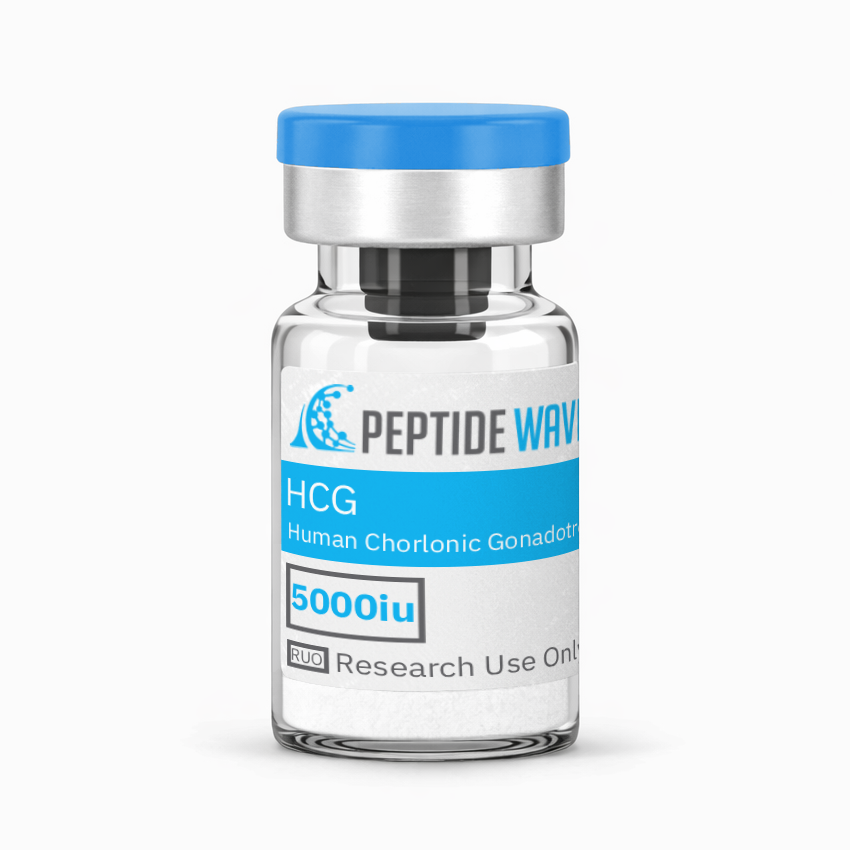
CAS Number: 9002-61-3
Molecular Formula: C₁₀₅₅H₁₇₇₀N₃₁₆O₃₀₆S₂₆
Molecular Weight: ~36,700 g/mol (glycoprotein, varies with glycosylation)
Sequence: Two subunits: α-subunit (92 amino acids) and β-subunit (145 amino acids)
What is Human Chorionic Gonadotropin (hCG)?
Human chorionic gonadotropin (hCG) is a hormone produced by the placenta during pregnancy, specifically by specialized cells known as syncytiotrophoblasts. The primary role of hCG is to support the early stages of pregnancy by maintaining the corpus luteum and ensuring the production of essential hormones until the placenta is fully developed. EBSCO
From the time of implantation, hCG produced by trophoblast cells takes over corpus luteal progesterone production from luteinizing hormone (LH), acting on a joint hCG/LH receptor. This continues for approximately 3 to 4 weeks, after which there are sufficient syncytiotrophoblast cells in the placenta to take over progesterone production from corpus luteal cells. PubMed Central
The molecule consists of two subunits:
-
α subunit: ~14.9 kDa (14.5 kDa glycoprotein, ~4.7 kDa carbohydrate)
-
β subunit: ~23 kDa (16.0 kDa polypeptide, ~7.0 kDa carbohydrate)
Approved Uses:
1. Female Infertility & Assisted Reproduction
Exogenous administration of hCG as a bolus is standard practice in vitro fertilization transfer care. hCG plays a crucial role in maintaining early pregnancy by supporting the corpus luteum, which in turn sustains progesterone production essential for maintaining the endometrium. NCBI
2. Male Hypogonadism & Testosterone Deficiency
HCG is used in the treatment of male infertility due to its luteinizing hormone (LH)-like action triggering testosterone and sperm production. Due to these positive effects on testosterone production, HCG has also been used to treat secondary hypogonadism. PubMed
A 2024 review emphasizes that for males with hypogonadism who wish to remain fertile, hCG and gonadotropin medications are the most reliable alternatives to testosterone replacement therapy, while other options remain experimental or limited by safety and practicality. Healthline
3. Male Infertility & Spermatogenesis
A recent study found that the mean total sperm count increased significantly from 18.0 million to 146.9 million after hCG treatment, and total motile sperm counts increased from 1.1 million at baseline to 66.9 million post-treatment. The number of men with a normal total motile sperm count increased from 5% to 58%. ScienceDirect
4. Cryptorchidism (Undescended Testicles)
hCG can also be used to treat undescended testicles, working by helping one or both testicles move into the scrotum. Cleveland Clinic
5. Tumor Marker / Cancer Diagnostics
hCG can be used as a tumor marker, as its β subunit is secreted by some cancers including seminoma, choriocarcinoma, teratoma with elements of choriocarcinoma, other germ cell tumors, hydatidiform mole, and islet cell tumor. For this reason, a positive result in males can be a test for testicular cancer. Combined with alpha-fetoprotein, β-HCG is an excellent tumor marker for the monitoring of germ cell tumors. Wikipedia
Areas of Active Research:
6. Prevention of Preterm Labor (Tocolytic Effect)
Studies provide strong evidence indicating that hCG inhibits the physiological and pathological processes of labor and could be utilized as a tocolytic agent to prevent preterm labor and birth. PubMed Central Pretreatment with hCG prevented endotoxin-induced preterm birth by 44%, proving the effectiveness of this hormone as an anti-inflammatory agent. PubMed However, researchers caution that hCG administration alone has also caused dystocia and fetal compromise in animal models, warranting careful further study.
7. Immune Modulation & Fetal Tolerance
hCG is crucially involved in implantation and placentation and determines fetal fate by regulating maternal innate and adaptive immune responses allowing the acceptance of foreign fetal antigens. As one of the first signals provided by the embryo to its mother, hCG has the potential to regulate very early pregnancy-driven immune responses, allowing the establishment and preservation of fetal tolerance. PubMed Central
Using immunophenotyping, researchers demonstrated that hCG has immune effects at the maternal-fetal interface by: (1) increasing the proportion of regulatory T cells; (2) reducing the proportion of macrophages and neutrophils; (3) inducing an M1→M2 macrophage polarization; and (4) increasing the proportion of T helper 17 cells. PubMed
8. Anti-Inflammatory Properties
hCG inhibits the expression of tumor necrosis factor alpha (TNFα) and interferon gamma (IFN-γ) at the maternal-fetal interface and decreases the rate of resorption in abortive mouse models. Research has shown that hCG significantly inhibits IL-6 and TNFα messenger RNA expression, indicating that hCG could inhibit the production of proinflammatory cytokines. PubMed Central
9. Potential Neuroprotection / Alzheimer’s Disease
A study investigated the effects of different doses of hCG on hCG receptor-immunoreactive neuron density in the prefrontal cortex and cerebellum of a rat model of streptozotocin-induced Alzheimer’s disease. hCG administration resulted in a significant dose-dependent increase in the number of hCG receptor-immunoreactive neurons in the prefrontal cortex and cerebellum. The same group showed that hCG attenuates amyloid-β plaques induced by streptozotocin in the rat brain by affecting cytochrome c-immunoreactive neuron density, suggesting hCG might be useful in patients with Alzheimer’s disease. PubMed Central
A 2026 review notes that dysregulated hCG levels have been associated with markers of neurotoxicity, including neuroinflammation, oxidative stress, and altered blood-brain barrier integrity, but evidence remains largely associative and causal mechanisms are not yet established. Springer
10. Angiogenesis & Placental Vascular Development
hCG activates the luteinizing hormone/hCG receptor leading to higher expression of heme oxygenase 1 (HO-1). HO-1 mediates pivotal actions of hCG on the fetomaternal interface, promoting maternal immune tolerance which allows the physiological vascular development of the placenta. ScienceDirect
11. Autoimmune Diabetes (Experimental)
Research published in Diabetologia has suggested that hCG can act as an immune modulator and prevent autoimmune diabetes in animal models (NOD mice), though this remains experimental and has not advanced to human clinical application.
Reviews
There are no reviews yet.