A peptide certificate of analysis is usually read for a single number. The purity figure sits near the top of the page, it is expressed to one or two decimal places, and it carries an implication of completeness that the document itself does not support.
That figure answers one narrow question: of the peptide-related material detected by a particular chromatographic method at a particular wavelength, what proportion eluted as the target peak. It says nothing about how much of the vial’s mass is peptide, nothing about what the remainder consists of, nothing about whether the material has aggregated, and nothing about endotoxin load. On most certificates in circulation, those attributes are not reported because they were not tested.
The argument of this article is that chromatographic purity is the least informative number on a well-populated certificate, and that the attributes governing whether an experiment produces an interpretable result are usually the ones absent from the page. That claim is not speculative. In 2026 a regulatory agency examined real peptide certificates in detail and published what it found, and the findings are set out below alongside the two attributes most likely to change a result without appearing on any document: net peptide content and the identity of the counterion.
What the Purity Figure Actually Measures
Reversed-phase high-performance liquid chromatography separates a sample by hydrophobicity and reports the target peak area as a proportion of total detected peak area. Three properties of that measurement constrain what the resulting number can mean.
It is wavelength-dependent. Detection is typically at 214 to 220 nm, where the peptide bond itself absorbs, which is why that range is chosen for peptides rather than the 280 nm commonly used for proteins. At 280 nm, absorbance depends on tryptophan, tyrosine, and to a lesser extent phenylalanine, so a peptide containing none of those residues is effectively invisible. A purity figure reported without its detection wavelength is incomplete, and figures obtained at different wavelengths are not directly comparable.
It is method-dependent. Purity is a property of a separation, not of a substance. An impurity that co-elutes with the target peak under one gradient may resolve under another, and a single method cannot establish that no co-eluting species is present. Orthogonal methods, meaning separations operating on a different physicochemical principle, are what establish that a peak is a single species. A certificate reporting one chromatographic method reports one method’s result.
It is blind to stereochemistry in most implementations. Solid-phase synthesis can produce diastereomers through racemisation at individual residues, and epimeric species frequently co-elute with the parent under standard reversed-phase conditions. A peptide containing a D-amino acid at one position may appear as part of the main peak.
The tier labels are supplier convention, not standards. Descriptions such as high precision, standard research, or crude appear across supplier documentation with varying thresholds attached, and no standards body defines them or maps them to recommended applications. They are useful as internal shorthand and should not be read as specifications.

What Mass Confirmation Establishes, and What It Cannot
Mass spectrometry answers the identity question that chromatography does not: it reports the observed molecular mass of the eluting species against the mass calculated from the intended sequence, and a match within a narrow tolerance is treated as identity confirmation.
The confirmation is real and it is narrower than usually assumed. Mass establishes elemental composition. It does not establish sequence.
Caveat on what a mass match proves: Several classes of incorrect product have the same mass as the correct one and therefore pass a routine mass check. Leucine and isoleucine are isomers with identical mass, so a substitution between them is invisible. A peptide whose residues have been assembled in the wrong order has identical composition and identical mass to the intended sequence. Aspartate isomerisation to isoaspartate changes the backbone connectivity without changing the mass at all. Distinguishing these requires tandem mass spectrometry, where the molecule is fragmented and the fragment masses read out the sequence, or independent amino acid analysis. A certificate reporting a single-stage mass measurement has confirmed that the material has the right composition, which is a weaker claim than having the right structure.
For most research applications a composition-level confirmation is adequate. It stops being adequate when the experimental question is sensitive to sequence detail, when a null result needs to be attributable to biology rather than to material, or when the compound in question is a fragment of a larger protein and the literature under comparison used a differently modified form. Investigators working with TB-500 as an actin-binding thymosin beta-4 fragment encounter exactly that situation, since the acetylated and non-acetylated heptapeptides differ by 42 Da and multiple truncation metabolites differ from the parent by single residues.
Purity Versus Net Peptide Content: The Mass That Is Not Peptide
This is the distinction that most often produces a systematic concentration error, and the arithmetic is unforgiving.
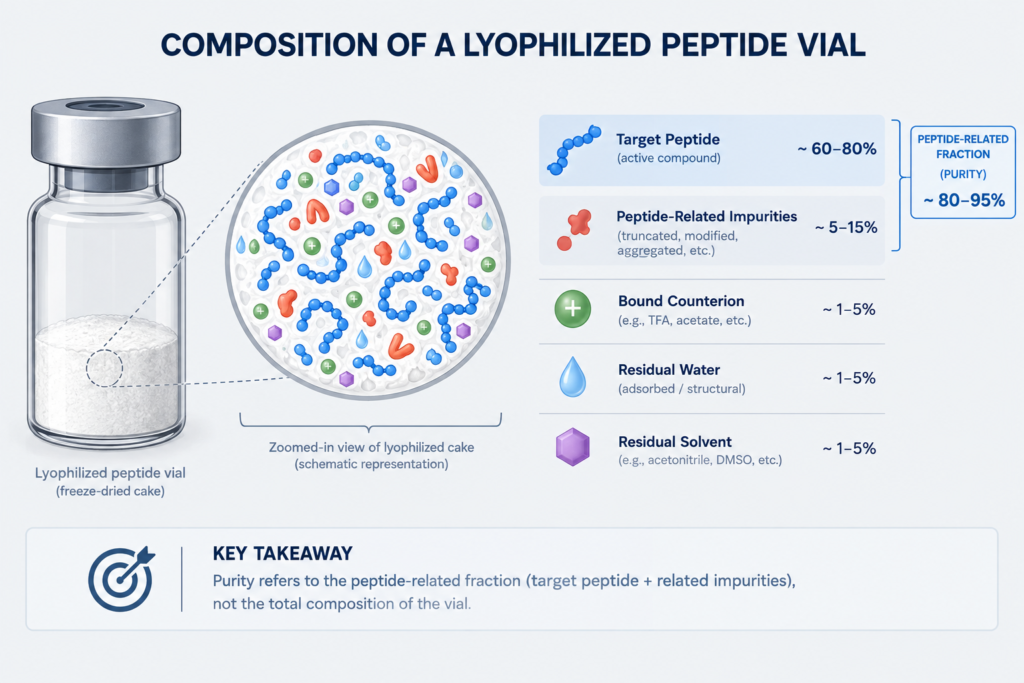
Purity is a ratio calculated among peptide-related species. Net peptide content is a proportion of total vial mass. A vial reported at 99 percent purity contains material of which 99 percent of the detected peptide is the target sequence. It does not follow that 99 percent of the powder is peptide, and typically a substantial fraction is not.
The non-peptide mass has three components. Counterions, bound to basic residues during synthesis and purification, and present in stoichiometric rather than trace quantity. Water, absorbed hygroscopically and retained through lyophilisation. Residual solvent from the synthesis and purification steps.
Net peptide content is determined by quantitative amino acid analysis, in which the peptide is hydrolysed and the liberated residues quantified against standards, or by nitrogen determination. Water content is determined separately, usually by Karl Fischer titration or loss on drying. A certificate reporting neither has not established net content, and gravimetric reconstitution against the nominal label mass will overstate the resulting concentration by whatever the non-peptide fraction happens to be.
Two consequences follow. Concentrations calculated from gross powder mass are upper bounds rather than values. And a shifted dose-response curve observed after changing supplier or lot should be checked against net content before it is attributed to biology, because a difference in counterion load between two batches produces exactly that pattern. Reconstitution planning against sterile bacteriostatic diluent should therefore start from measured content where it is available rather than from label mass.
The Counterion Is Not Inert
Most treatments of net peptide content stop at the arithmetic, treating the non-peptide fraction as ballast that dilutes the calculation. The more consequential problem is that one common counterion is biologically active in the concentration range that routine reconstitution produces.
Solid-phase peptide synthesis cleaves the product from its resin using trifluoroacetic acid, and TFA is also the standard ion-pairing agent in reversed-phase purification. Peptides therefore arrive as trifluoroacetate salts by default unless a deliberate exchange step has been performed. The ion pairs persistently with cationic residues, and a critical evaluation of exchange methods (Roux and colleagues, 2007) describes the counterion as tightly bound and requiring a dedicated procedure to displace, with the classical approach of repeated lyophilisation against a stronger acid carrying its own degradation risk.
The assay consequence was documented directly. Cornish and colleagues (Bone, 1999) reported that trifluoroacetate at 10 to 100 nanomolar reduced cell numbers and thymidine incorporation in fetal rat osteoblast cultures, with comparable effects in articular chondrocyte and neonatal calvarial cultures, indicating the effect was neither cell-type nor species specific. The critical comparison came next: testing TFA and hydrochloride salts of the same peptides side by side, cell proliferation was consistently lower with the TFA salt, which the authors describe as resulting in failure to detect a proliferative effect, or in wrongly attributing an antiproliferative effect.
That is the point worth carrying out of this article. The counterion did not add noise to the measurement. It inverted the conclusion.
Further mechanistic work has reported trifluoroacetate activity at several receptor and channel targets at higher concentrations, including a lactate receptor, a free fatty acid receptor, ATP-sensitive potassium channels, and allosteric modulation of the glycine receptor, and has documented systematic phenotypic effects from peptides intended as inactive negative controls (preprint, 2025, not yet peer reviewed). Preprint status should temper how much weight that work carries, but the direction is consistent with the 1999 cell-culture findings.
The practical reading is straightforward. Acetate content or counterion identity on a certificate is not a housekeeping line. For proliferation, cytotoxicity, receptor binding, and antimicrobial susceptibility work in particular, it is a variable in the experiment, and studies comparing compounds supplied as different salts are comparing two things at once.
Prerequisite Condition: What a Regulator Found When It Audited Real Certificates
The gap between what a certificate reports and what governs an experiment is not a matter of opinion. It was documented in detail during the United States Food and Drug Administration’s 2026 evaluation of peptides nominated for compounding use, and the evaluation of TB-500-related substances contains the most specific public account available of what real peptide certificates do and do not contain.
For the free base form, the agency located no certificate in the nomination package at all and searched the public domain for a representative example. The document it found reported appearance, identity by liquid chromatography-mass spectrometry and by HPLC, and peptide purity. Assay, impurities, bacterial endotoxins, and aggregates were neither tested nor controlled.
The certificate supplied by the nominator for the acetate form was more complete, covering appearance, solubility, amino acid composition, water, acetate content, impurities by HPLC with limits of no more than 2.0 percent total and no more than 1.0 percent for the largest single impurity, and purity. It provided no results for identification, assay, aggregates, or bacterial endotoxin.
The agency’s commentary on aggregation is worth reading closely, because it is the attribute most often assumed to be irrelevant for small peptides. The evaluation notes that peptides are sensitive to formulation, process, and environmental conditions including pH, temperature, concentration, in-process impurities, and excipients, which may lead to aggregation and degradation and loss of biological activity, citing Zapadka and colleagues (2017), and that detecting the various aggregate species may require multiple analytical methods such as size exclusion chromatography or field flow fractionation. It further observes that peptides with as few as two amino acids have been shown to aggregate.
A related finding concerns identity itself. The agency recorded that on several suppliers’ websites the CAS number belonging to the free base was applied to the acetate form, and that within a single nomination package the substance was listed as free base while the accompanying certificate was for the acetate, with a molecular formula matching neither.
| Attribute | What it establishes | Commonly on a research CoA | What its absence permits |
| Identity by LCMS or HPLC | Composition matches the intended sequence | Yes | Little; this is the best-covered attribute |
| Peptide purity by HPLC | Proportion of peptide-related material that is target | Yes | Co-eluting and epimeric species under one method |
| Counterion content | Which salt form, and how much | Sometimes | Unquantified TFA load acting as an assay variable |
| Water content | Non-peptide mass from moisture | Sometimes | Overstated concentration from gravimetric reconstitution |
| Assay or net peptide content | Mass of peptide per unit of powder | Rarely | Systematic concentration error of unknown magnitude |
| Individual impurity identity | What the non-target peptide species are | Rarely | Truncation and deletion species of unknown activity |
| Aggregate content | Monomer versus higher-order species | Rarely | Reduced effective monomer concentration; altered pharmacology |
| Bacterial endotoxin | Pyrogenic contamination load | Rarely | Confounded inflammatory, immune, and cytokine endpoints |
The final row deserves separate emphasis. Endotoxin is a potent and independent stimulus of inflammatory signalling, and an uncontrolled endotoxin load in a reagent used for an inflammatory or immune endpoint produces an effect that is real, reproducible, and entirely unrelated to the compound under study.
How to Read the Document in Practice
Reading order matters, because the informative content is not at the top of the page.
Begin with the identity block and check that the salt form named there matches the salt form the molecular weight and CAS number correspond to. Internal inconsistency between those fields is common enough that a regulator flagged it, and it determines which formula weight the molarity calculation should use.
Read the purity figure with its method attached. A number without a stated wavelength, gradient, and column is a number without context, and it is not comparable to a figure obtained under different conditions.
Look next for what is absent. Net peptide content, water, counterion content, aggregate, and endotoxin are the attributes that determine whether a concentration is accurate and whether an endpoint is confounded, and each is more consequential than a second decimal place on the purity line.
Match the analytical package to the experiment rather than to a general quality preference. Proliferation and cytotoxicity work needs counterion identity. Inflammatory and immune endpoints need endotoxin. Any quantitative concentration-response work needs net content. Structural or binding work sensitive to sequence detail needs tandem mass confirmation rather than a single-stage mass match.
Finally, treat the batch as the unit rather than the product. A certificate describes one lot. Documentation that is not batch-specific, or that cannot be tied to the material in hand by lot number, describes a different sample. Peptide Wave provides a batch-specific certificate of analysis on request. Before relying on any certificate, including ours, for a concentration-sensitive experiment, check which of the attributes above it reports.

Frequently Asked Questions
Q1: Does 99 percent purity mean the vial is 99 percent peptide?
Direct Answer: No. Purity is a ratio calculated among peptide-related species detected by chromatography, while the proportion of total vial mass that is peptide is a separate quantity called net peptide content, and the two are frequently reported without distinction.
- What makes up the difference: Counterions bound to basic residues, hygroscopically absorbed water, and residual solvent, none of which appear in a purity calculation.
- How net content is determined: Quantitative amino acid analysis after hydrolysis, or nitrogen determination, with water measured separately by Karl Fischer titration or loss on drying.
- Consequence if unmeasured: Concentrations calculated from gross powder mass are upper bounds, and the error is systematic rather than random.
Q2: Can mass spectrometry confirm that a peptide has the correct sequence?
Direct Answer: A single-stage mass measurement confirms elemental composition rather than sequence, so several classes of incorrect product pass the check, and sequence confirmation requires tandem mass spectrometry or independent amino acid analysis.
- Isomeric residues: Leucine and isoleucine have identical mass, so a substitution between them is invisible to a mass check.
- Sequence scrambling: A peptide assembled in the wrong order has identical composition and identical mass to the intended product.
- Backbone isomerisation: Aspartate to isoaspartate conversion changes connectivity without changing mass.
Q3: Why does the counterion matter if it is not part of the peptide?
Direct Answer: Trifluoroacetate, the default counterion from solid-phase synthesis and reversed-phase purification, is biologically active at nanomolar concentrations and has been shown to alter cell proliferation measurements independently of the peptide it accompanies.
- Documented effect: Trifluoroacetate at 10 to 100 nanomolar reduced cell numbers and thymidine incorporation across osteoblast, chondrocyte, and calvarial cultures.
- Effect on conclusions: Side-by-side comparison of TFA and hydrochloride salts of the same peptides produced failure to detect a real proliferative effect, and wrongly attributed antiproliferative effects.
- Which experiments are affected: Proliferation, cytotoxicity, receptor binding, and antimicrobial susceptibility work are the most sensitive.
Q4: Why is endotoxin testing important for a peptide reagent?
Direct Answer: Endotoxin is an independent and potent stimulus of inflammatory signalling, so an uncontrolled load in a reagent used for inflammatory, immune, or cytokine endpoints produces a real and reproducible effect unrelated to the compound under study.
- Frequency of testing: Regulatory review of representative peptide certificates found endotoxin neither tested nor controlled on the documents examined.
- Which endpoints are exposed: Any readout downstream of pattern recognition receptor signalling.
- Why purity does not cover it: Endotoxin is not a peptide-related species and does not appear in a chromatographic purity calculation.
Q5: Do aggregates matter for short peptides?
Direct Answer: Yes. Peptides with as few as two amino acids have been shown to aggregate, and aggregation reduces effective monomer concentration and can alter pharmacology, so a nominal concentration may not describe the species actually present.
- What drives it: Sensitivity to pH, temperature, concentration, in-process impurities, and excipients during formulation, processing, and storage.
- Why standard HPLC does not detect it: Detection generally requires size exclusion chromatography or field flow fractionation, and multiple methods may be needed for different aggregate species.
- Reporting frequency: Aggregate content was absent from both certificates examined in the regulatory review described above.
Q6: What should be checked first on a certificate of analysis?
Direct Answer: The identity block, specifically whether the salt form named there is consistent with the molecular weight and CAS number reported alongside it, because that consistency determines which formula weight every subsequent calculation should use.
- Documented inconsistency: Regulatory review found a free base CAS number applied to acetate material across multiple supplier listings, and a nomination package whose stated form, certificate, and molecular formula did not agree.
- Second check: The purity figure with its detection wavelength and chromatographic method attached, since a figure without method is not comparable across documents.
- Third check: Which attributes are absent, since those govern whether a concentration is accurate and whether an endpoint is confounded.

What a Certificate Can and Cannot Settle
A certificate of analysis establishes that a particular lot contained material of a given composition at a given chromatographic purity under a given method. That is a real and necessary confirmation, and material without it should not enter an experiment.
It does not, on most documents in circulation, establish how much of the vial is peptide, which counterion is present or in what quantity, whether the material has aggregated, or what the endotoxin load is. Those four attributes determine whether a calculated concentration is accurate and whether an observed effect belongs to the compound, and a regulatory review of representative certificates in 2026 found each of them absent from the documents it examined.
The reading rule that follows is to match the analytical package to the experimental question rather than to a general standard of quality. A binding assay and an inflammatory endpoint have different vulnerabilities, and a certificate that is adequate for one may leave the other unprotected. Where a required attribute is missing, the options are to request the full analytical package, to obtain the measurement independently, or to state in the methods that the attribute was uncontrolled. The one option that is not available is to assume that a high purity figure covers it, because purity is a statement about the peptide-related fraction of the material and most of what can compromise an experiment sits outside that fraction.
This article is provided for scientific reference in preclinical and in vitro research contexts. It does not describe or recommend any use in humans or animals. Compounds discussed are not approved by Health Canada for any therapeutic indication.
All Peptide Wave products are intended strictly for laboratory research use only. Not approved for, nor intended for, human or veterinary consumption.
Ready to Advance Your Research?
Browse our catalog of verified research peptides, sourced and shipped exclusively within Canada. COAs available on request.
Disclaimer: All Peptide Wave products are intended strictly for laboratory research use only. Not approved for, nor intended for, human or veterinary consumption.