Comparing GHRH-R and GHS-R1a signaling and somatostatin-axis response in endocrine research models.
In molecular endocrinology and preclinical research, evaluating somatotroph axis stimulation requires a fundamental distinction between directly introducing exogenous hormones and modulating endogenous secretion pathways. The growth hormone (GH) axis, driven by complex hypothalamic-pituitary signaling, regulates protein synthesis, cellular proliferation, substrate utilization, and matrix deposition across diverse cellular systems.
For preclinical investigators evaluating somatotroph signaling compounds, choosing between exogenous recombinant human growth hormone (rhGH) and growth hormone secretagogues depends on the specific biological questions under study. Recombinant growth hormone directly saturates peripheral and hepatic growth hormone receptors (GHR), providing immediate downstream signal transduction. However, this continuous, tonic engagement bypasses native hypothalamic regulation and engages strong negative feedback loops that suppress endogenous pituitary production.
In contrast, growth hormone secretagogues operate upstream at the pituitary level. By targeting distinct cell-surface receptors on pituitary somatotrophs, these agents stimulate the synthesis and exocytosis of native growth hormone in pulsatile secretory patterns. This approach preserves natural somatostatin feedback architecture while maintaining endogenous receptor sensitivity. Understanding these distinct mechanisms allows research teams to select the appropriate preclinical model for cell culture, tissue culture, or animal research protocols.
Direct Receptor Saturation: Exogenous Growth Hormone Dynamics
Exogenous recombinant human growth hormone consists of a single-chain 191-amino-acid polypeptide that replicates native pituitary GH. Upon administration in experimental models, exogenous rhGH bypasses the hypothalamus and anterior pituitary entirely, circulating directly to target tissue sites.
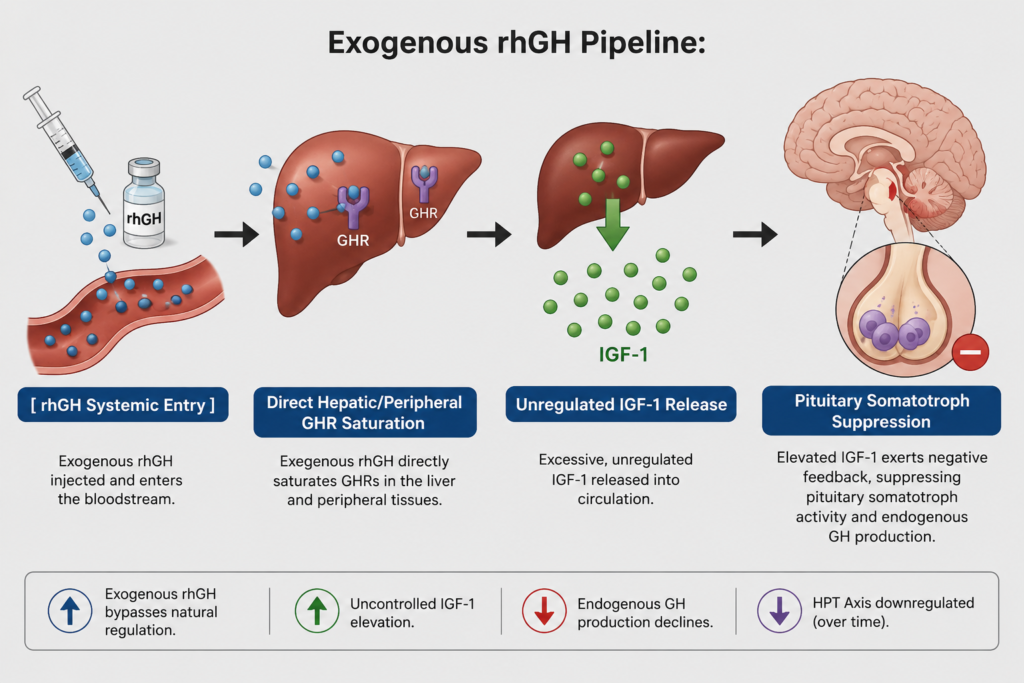
At the target cell membrane, one molecule of exogenous GH binds sequential binding sites on two adjacent growth hormone receptor monomeric subunits. Ligand binding induces a conformational reorientation of the preformed receptor dimer, repositioning the associated JAK2 kinases for transactivation. Activated JAK2 transphosphorylates specific tyrosine residues on the cytoplasmic tails of the receptor, creating docking sites for Signal Transducer and Activator of Transcription 5 (STAT5b). Once phosphorylated, STAT5b dimerizes and translocates to the nucleus to regulate the transcription of target genes, including insulin-like growth factor 1 (IGF-1) and IGF-binding protein 3 (IGFBP-3).
While exogenous rhGH reliably stimulates downstream cascades, its kinetic profile exhibits specific characteristics in preclinical models:
- Tonic Level Saturation: Exogenous delivery creates a sustained, elevated plateau of circulating hormone rather than the natural, high-amplitude spikes observed in intact physiology.
- Hypothalamic-Pituitary Suppression: High circulating levels of GH and secondary IGF-1 trigger hypothalamic somatostatin (SRIF) release while inhibiting growth hormone-releasing hormone (GHRH) secretion. This activates negative feedback mechanisms that suppress endogenous somatotroph synthesis.
- Receptor Downregulation: Prolonged exposure to non-pulsatile, elevated concentrations of exogenous ligand can induce receptor internalization and desensitization across target tissue interfaces.
Upstream Secretagogue Pathways: GHRH Analogs
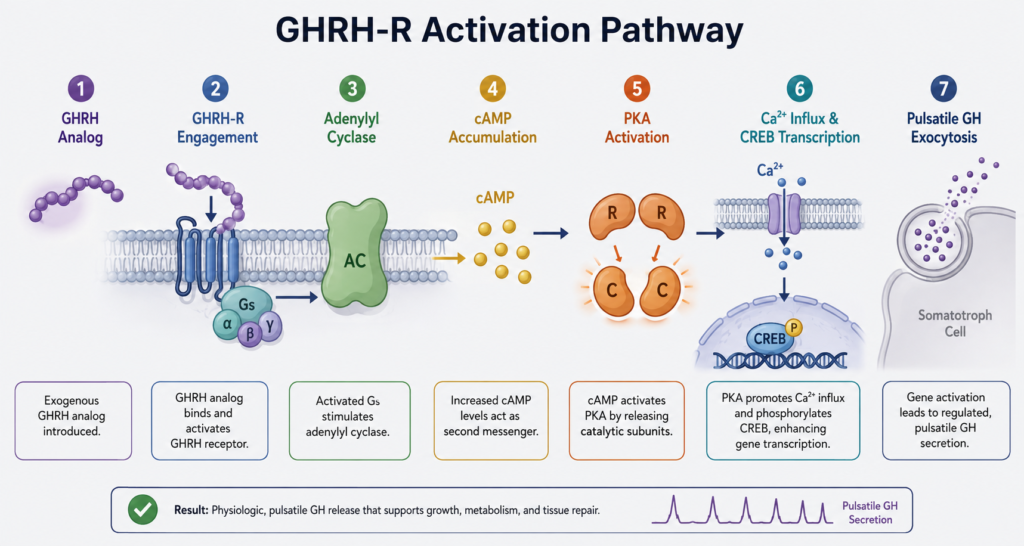
Growth hormone-releasing hormone (GHRH) analogs represent a primary class of secretagogues that stimulate the somatotroph axis via direct engagement with the GHRH receptor (GHRH-R). GHRH-R is a class B G-protein-coupled receptor located on the anterior pituitary somatotroph membrane. Ligand binding to GHRH-R activates the heterotrimeric G-protein Gs alpha subunit, which stimulates membrane-bound adenylyl cyclase. Adenylyl cyclase catalyzes the conversion of adenosine triphosphate (ATP) into cyclic adenosine monophosphate (cAMP).
Elevated intracellular cAMP levels activate protein kinase A (PKA), leading to the phosphorylation of L-type voltage-gated calcium channels. The Journal of Clinical Endocrinology & Metabolism published findings showing that the resulting influx of extracellular calcium ions (Ca^{2+}), alongside PKA-mediated activation of the cAMP response element-binding protein (CREB), drives both the immediate exocytosis of stored GH secretory granules and the transcription of new GH mRNA.
Within this category, key structural variants provide distinct pharmacokinetic profiles for preclinical experimental designs:
- Sermorelin: A truncated synthetic 29-amino-acid peptide representing the biologically active N-terminal sequence of native GHRH (1-29). Sermorelin exhibits a short biological half-life (approximately 10 to 12 minutes in circulating media) due to rapid cleavage by dipeptidyl peptidase-IV (DPP-IV) and neutral endopeptidases. Historically utilized in pediatric endocrinology diagnostic protocols and pituitary responsiveness assays, Sermorelin serves as a classic benchmark for acute GHRH-R stimulation models.
- CJC-1295 (No DAC / Mod GRF 1-29) and CJC-1295 DAC: Engineered to overcome rapid enzymatic degradation, CJC-1295 No DAC is a tetrasubstituted 29-amino-acid GHRH analog whose substitutions confer resistance to DPP-IV cleavage, reported to extend plasma half-life into the range of tens of minutes. The variant incorporating a Drug Affinity Complex features a maleimidopropionic acid group that covalently binds circulating serum albumin, extending half-life to several days.
Note on pulsatility: The DAC variant is a deliberate exception to the pulsatile framework described throughout this comparison. Sustained GHRH-R occupancy across a multi-day half-life produces a persistently elevated GH and IGF-1 baseline rather than discrete secretory bursts, a kinetic profile closer to tonic exposure than to native pulsatility. Investigators selecting DAC should treat it as a model of continuous upstream stimulation, not preserved pulsatile architecture. No-DAC variants and short-acting analogs remain the appropriate choice for pulsatility-dependent assays.
- Tesamorelin: A stabilized GHRH analog featuring a trans-3-hexenoic acid group attached to the N-terminal tyrosine residue of the 44-amino-acid native GHRH sequence. This modification provides enhanced resistance to DPP-IV degradation while preserving high binding affinity for GHRH-R. Tesamorelin is the most extensively studied compound in this class, with peer-reviewed clinical literature evaluating visceral adipose tissue endpoints (Falutz et al., NEJM, 2007).
Prerequisite Condition: Intact Somatotroph Reserve
The single most consequential variable in choosing between these classes is whether the experimental model retains a functional pituitary.
Exogenous rhGH acts distal to the pituitary and therefore produces GHR activation independent of somatotroph status. It remains viable in hypophysectomized models, somatotroph-ablated preparations, isolated hepatocyte culture, and any system lacking hypothalamic-pituitary input.
Every secretagogue described above is functionally dependent on three intact upstream conditions: viable somatotrophs, adequate stored GH granule reserve, and expressed receptor populations (GHRH-R, GHS-R1a). Where any of these is absent or depleted, secretagogue administration produces attenuated or null response, an outcome that reflects model limitation rather than compound inactivity.
Practical implications for assay design:
- Granule depletion vs. desensitization: Repeated high-amplitude stimulation can exhaust releasable GH stores. A declining response curve should be tested against both explanations before being attributed to receptor internalization.
- Age and model state: Somatotroph reserve and GHRH-R expression decline with age in standard rodent models, producing dose-response shifts unrelated to the compound under study.
- Ceiling effects: Secretagogue response is bounded by endogenous synthetic capacity. Studies requiring supraphysiological GH concentrations cannot achieve them through secretagogue stimulation at any dose.
- Reagent verification: Before attributing a shifted dose-response curve to biology, check net peptide content and counterion on the certificate of analysis.
Dual Receptor Synergism: Ghrelin Receptor Agonists (GHRPs and Non-Peptides)
A distinct class of growth hormone secretagogues operates through the growth hormone secretagogue receptor 1a (GHS-R1a), commonly referred to as the ghrelin receptor. GHS-R1a is a class A G-protein-coupled receptor expressed both on pituitary somatotrophs and within hypothalamic nuclei.
Ligand binding to GHS-R1a activates the Gq/11 alpha protein subunit, initiating signaling through the phospholipase C (PLC) pathway. PLC cleaves membrane phosphatidylinositol 4,5-bisphosphate (PIP2) into diacylglycerol (DAG) and inositol 1,4,5-trisphosphate (IP3). IP3 binds to specific receptors on the endoplasmic reticulum, triggering the rapid mobilization of intracellular calcium stores. Simultaneously, DAG activates protein kinase C (PKC), which inhibits voltage-gated potassium channels, maintaining membrane depolarization and promoting sustained calcium influx.
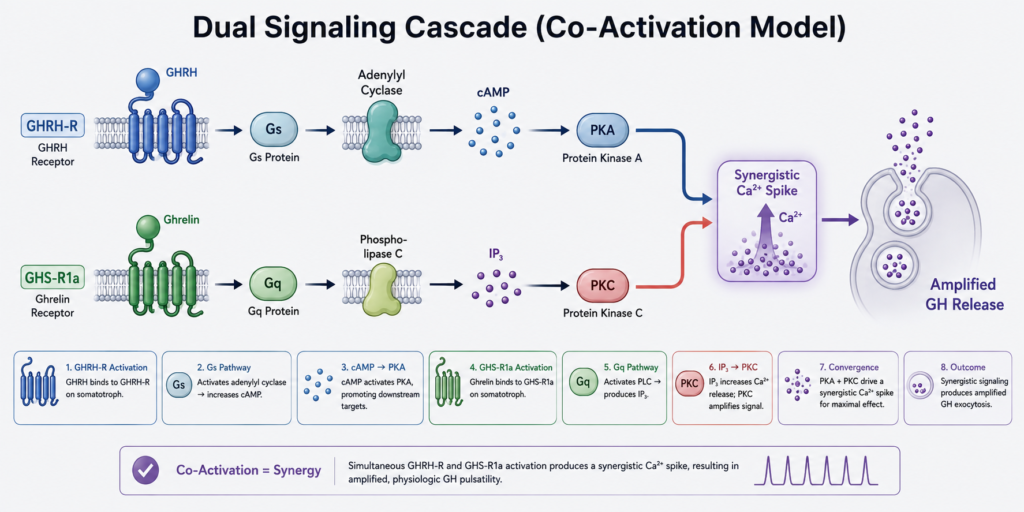
The synergy observed with GHRH-analog and GHRP co-administration (first demonstrated in normal men by Bowers et al., J Clin Endocrinol Metab, 1990) is not solely a product of intracellular second-messenger convergence at the somatotroph. GHS-R1a agonists act at three distinct levels, which together account for a response exceeding the sum of either agent alone:
- Somatotroph convergence: Parallel cAMP/PKA and IP3/PKC/Ca²⁺ cascades produce an amplified intracellular calcium spike and enhanced granule exocytosis.
- Hypothalamic GHRH neuron stimulation: GHS-R1a expression in the arcuate nucleus means ghrelin receptor agonists stimulate endogenous GHRH release, adding native ligand to the administered analog.
- Functional somatostatin antagonism: GHS-R1a activation opposes somatostatinergic tone at the somatotroph, effectively raising the ceiling on GHRH-driven release rather than simply adding to it.
This third mechanism is the reason co-administration outcomes are described as synergistic rather than additive, one agent removes the inhibitory constraint limiting the other.
When GHRH-R agonists and GHS-R1a agonists are evaluated together in experimental models, such as the CJC-1295 + Ipamorelin Blended Reagents, their distinct intracellular cascades (cAMP/PKA and IP3/PKC/Ca^{2+}) converge, producing a synergistic release of growth hormone that exceeds the additive response of either agent alone.
Specific compounds within the ghrelin receptor agonist category exhibit distinct receptor binding characteristics and secondary biological effects:
- GHRP-6: The foundational synthetic hexapeptide in the growth hormone-releasing peptide class. GHRP-6 binds GHS-R1a to induce robust GH pulses. Due to its engagement of central ghrelin receptors in the arcuate nucleus of the hypothalamus, GHRP-6 produces the strongest appetite stimulation among the GHRP series, making it a valuable tool in preclinical hyperphagia and metabolic research.
- GHRP-2: A second-generation synthetic hexapeptide with higher potency at GHS-R1a compared to GHRP-6. It generates moderate-to-strong GH pulses with less pronounced appetite stimulation than GHRP-6. However, GHRP-2 displays mild cross-reactivity with central ACTH and prolactin pathways, leading to measurable, dose-dependent increases in plasma cortisol and prolactin in preclinical models.
- Hexarelin: A hexapeptide structural analog that produces the highest magnitude of GH release per dose among the GHRP category. Because of its high intrinsic activity, Hexarelin exhibits faster receptor desensitization (tachyphylaxis) upon repeated administration compared to lighter agonists. Notably, Hexarelin binds to CD36 scavenger receptors expressed in cardiac tissue, a binding interaction documented in cardiac tissue models and distinct from its GHS-R1a activity, a unique mechanistic feature within this class.
- Ipamorelin: A pentapeptide engineered specifically for target receptor selectivity. Ipamorelin selectively engages GHS-R1a without stimulating secondary endocrine axes. In comparative preclinical assays, Ipamorelin demonstrates virtually zero cross-reactivity with ACTH, cortisol, prolactin, or appetite effects (Raun et al., European Journal of Endocrinology, 1998), though appetite effects are present but markedly attenuated relative to GHRP-6, making it a precise model for isolated GHS-R1a signaling studies.
- MK-677 (Ibutamoren): A non-peptide, orally bioavailable spiropiperidine compound that acts as a potent, long-acting GHS-R1a agonist. MK-677 demonstrates that ghrelin receptor activation is not limited to peptide structures. In preclinical research models, MK-677 maintains elevated, pulsatile GH and IGF-1 levels over a 24-hour period following a single dose, providing a non-peptide alternative for studying long-term somatotroph axis activation.
Metabolic caveat: MK-677’s sustained receptor occupancy separates it from short-acting GHRPs on metabolic endpoints. Controlled human data (Nass et al., Annals of Internal Medicine, 2008) documented increased fasting blood glucose and reduced insulin sensitivity over a 12-month administration period. In metabolic research models, MK-677 should therefore not be assumed to share the glycemic profile of pulsatile injectable secretagogues.
Comparing Biological Mechanisms: Exogenous GH vs. Secretagogues
Evaluating exogenous growth hormone alongside GHRH analogs and ghrelin receptor agonists highlights clear differences in receptor kinetics, feedback loop behavior, and physiological dynamics:
| Feature / Pathway Parameter | Exogenous Growth Hormone (rhGH) | GHRH Analogs (e.g., Sermorelin, CJC-1295, Tesamorelin) | Ghrelin Receptor Agonists (e.g., Ipamorelin, Hexarelin, MK-677) |
| Primary Target Site | Hepatic & Peripheral Growth Hormone Receptors (GHR) | Pituitary Somatotroph GHRH Receptors (GHRH-R) | Pituitary & Central Ghrelin Receptors (GHS-R1a) |
| Intracellular Cascade | JAK2 / STAT5b phosphorylation pathway | Adenylyl Cyclase / cAMP / PKA pathway | Phospholipase C / IP3 / PKC / Ca^{2+} pathway |
| Secretion Profile | Continuous, non-pulsatile receptor engagement | Amplifies natural, pulsatile secretory bursts | Triggers acute, high-amplitude GH pulses |
| Pituitary Axis Preservation | Suppresses native somatotroph synthesis via negative feedback | Preserves native synthesis and pituitary responsiveness | Maintains endogenous secretory capability |
| Somatostatin (SRIF) Interaction | Overridden by direct hormone administration | Operates within natural somatostatin inhibitory windows | Partially counteracts somatostatin inhibition at pituitary level |
| Secondary Axis Effects | Direct peripheral metabolic shifting (lipolysis, insulin resistance) | Selective for GH axis; minimal off-target effects | Variable: Ipamorelin is selective; GHRP-2/6 affect cortisol/appetite |

Frequently Asked Questions
Q1: How do growth hormone secretagogues differ from exogenous growth hormone in mechanism?
Growth hormone secretagogues act upstream by binding GHRH (GHRH-R) or ghrelin (GHS-R1a) receptors on anterior pituitary somatotrophs, stimulating the synthesis and pulsatile release of native growth hormone. Exogenous growth hormone bypasses the pituitary gland, directly binding peripheral growth hormone receptors and suppressing endogenous hormone production via negative feedback loops.
- Secretagogues: Preserve pituitary axis architecture and natural, pulsatile secretion dynamics.
- Exogenous GH: Delivers direct, non-pulsatile receptor engagement while downregulating endogenous somatotroph function.
Q2: What is the mechanistic advantage of combining a GHRH analog with a GHRP in research?
Combining a GHRH analog (such as CJC-1295 or Tesamorelin) with a GHS-R1a agonist (such as Ipamorelin) produces a synergistic release of growth hormone. GHRH analogs activate the intracellular cAMP/PKA pathway, while GHS-R1a agonists trigger the IP3/PKC/Ca^{2+} pathway. Co-activating these parallel signaling pathways amplifies intracellular calcium influx and exocytosis of stored growth hormone granules beyond what either compound can achieve individually.
- GHRH-R Pathway: Increases cAMP synthesis and GH gene transcription.
- GHS-R1a Pathway: Mobilizes intracellular Ca^{2+} and inhibits somatostatin-mediated suppression.
Q3: Why does IGF-1 remain elevated after the GH pulse has cleared?
- Direct Answer: GH and IGF-1 operate on different timescales. A secretagogue-induced GH pulse rises and clears within roughly 2–3 hours, while IGF-1 is hepatically synthesized in response to that pulse, circulates bound to IGFBP-3 and the acid-labile subunit, and has a half-life measured in hours to days. Serum IGF-1 therefore reflects cumulative GH exposure across days rather than any single pulse.
- Assay implications: Single-timepoint IGF-1 measurement cannot resolve pulse amplitude or frequency. Studies evaluating pulsatile character require serial GH sampling.
- Ternary complex stabilization: IGFBP-3 binding extends IGF-1 half-life substantially over free IGF-1, decoupling the two markers temporally.
- Compound comparison: Long-acting agents produce steadier IGF-1 elevation than short-acting agents delivering equivalent total GH, because sustained hepatic stimulation avoids inter-pulse decay.
Q4: How does somatostatin (SS) regulate the threshold response of growth hormone secretagogues in preclinical assays?
- Direct Answer: Somatostatin acts as the primary physiological inhibitor of growth hormone release by binding to somatostatin receptors (SST) on pituitary somatotrophs, inhibiting adenylate cyclase activity and reducing intracellular calcium influx. Secretagogues work within this inhibitory feedback architecture, meaning endogenous somatostatin tone dictates the peak amplitude of secretagogue-induced GH pulses.
- Intracellular Crosstalk: Somatostatin binding activates inhibitory G-protein (Gi) subunits, counteracting the cAMP accumulation initiated by GHRH receptor stimulation.
- GHS-R1a Counter-Inhibition: Ghrelin receptor agonists (such as Ipamorelin) partially blunt somatostatin suppression, enabling sustained calcium mobilization even during periods of elevated somatostatic tone.
- Assay Timing Sensitivity: In vitro and ex vivo models must account for baseline somatostatin concentration, as high somatostatic baseline levels attenuate secretagogue responsiveness without indicating receptor desensitization.
Q5: Why do GHRH analogs and GHRPs display intracellular synergy when co-administered in cell culture models?
- Direct Answer: GHRH analogs and GHRPs trigger distinct, complementary intracellular second-messenger pathways within pituitary somatotrophs. Co-activating both pathways produces a synergistic intracellular calcium surge that significantly exceeds the additive response of either compound alone.
- Dual Signal Cascades: GHRH receptor activation elevates cyclic AMP (cAMP) and Protein Kinase A (PKA), while GHS-R1a binding stimulates phospholipase C (PLC), generating inositol trisphosphate (IP3) and diacylglycerol (DAG).
- Excitation-Secretion Coupling: IP3 triggers immediate calcium release from the endoplasmic reticulum, while PKA phosphorylation opens L-type voltage-gated calcium channels, driving rapid exocytosis of pre-stored GH vesicles.
- Desensitization Prevention: Combining low molar concentrations of both classes minimizes agonist-induced receptor internalization while maintaining robust target signaling.
Q6: How do growth hormone secretagogues impact serum insulin and carbohydrate metabolism relative to direct exogenous GH exposure?
- Direct Answer: Continuous exposure to exogenous GH induces peripheral insulin resistance by stimulating hepatic gluconeogenesis and suppressing peripheral glucose uptake. Short-acting secretagogues produce pulsatile GH elevation with inter-pulse baseline normalization, which is associated with less sustained metabolic disruption. This advantage is a function of exposure kinetics, not compound class, long-acting secretagogues that eliminate the inter-pulse trough do not retain it.
- Pulsatile vs. Tonic Exposure: Constant receptor saturation blunts insulin signaling downstream of IRS-1. This applies to any agent producing continuous GH elevation, including CJC-1295 DAC and MK-677, not exogenous rhGH alone.
- Duration Stratification: Short-acting agents (Sermorelin, Ipamorelin, GHRP-2, Mod GRF 1-29) preserve trough intervals; long-acting agents (DAC variants, MK-677) do not.
- Documented Exception: MK-677 has been shown to raise fasting glucose and reduce insulin sensitivity over sustained administration, despite acting through an endogenous-release mechanism.

Evaluating Somatotropic Axis Interventions in Preclinical Research Design
Exogenous recombinant GH and growth hormone secretagogues answer different experimental questions. Recombinant GH activates hepatic and peripheral GH receptors directly, independent of pituitary status, which makes it the appropriate tool for isolating downstream receptor signaling and for models without a functional pituitary. Its limitation as a model is that sustained exposure suppresses endogenous somatotroph output through negative feedback, so it cannot be used to study the axis it bypasses.
Secretagogues act upstream, through GHRH-R and cAMP/PKA signaling or GHS-R1a and IP3/calcium signaling, and their output depends on an intact pituitary. Short-acting agents such as CJC-1295 without DAC, ipamorelin and sermorelin retain pulsatile release and somatostatin feedback; long-acting agents such as CJC-1295 with DAC and MK-677 do not, and behave closer to tonic exposure on metabolic endpoints. Co-administering the two receptor classes produces a greater-than-additive GH response, which is itself a variable to control when the two are compared.
The practical rule is to choose by the question. Studies of downstream GH receptor signaling, or in models lacking a pituitary, call for recombinant GH. Studies of pituitary responsiveness, pulsatility, feedback or receptor sensitivity call for a secretagogue matched to the required exposure profile, in a model whose somatotroph reserve has been confirmed.
Disclaimer: This article is provided for scientific reference in preclinical and in vitro research contexts. It does not describe or recommend any use in humans or animals. Where a compound discussed is approved as a prescription product, that approval applies to the licensed pharmaceutical product in its approved indication, not to research-grade material.
Ready to Advance Your Research?
Browse our catalog of verified research peptides, sourced and shipped exclusively within Canada. COAs available on request.
Disclaimer: All Peptide Wave products are intended strictly for laboratory research use only. Not approved for, nor intended for, human or veterinary consumption.