In modern biochemical and preclinical research, experimental reproducibility depends entirely on reagent purity and structural fidelity. Synthesized peptides, prized for their high target specificity across metabolic pathways and cellular signaling cascades, represent some of the most thermodynamically sensitive molecules utilized in contemporary laboratory research. For Canadian academic, biological, and preclinical research laboratories utilizing Canadian research peptides, obtaining reliably high-purity compounds requires navigating critical logistical hurdles alongside strict analytical standards.
Historically, many research institutions sourced compounds internationally. However, evaluating domestic vs international peptide sourcing reveals that cross-border supply chains introduce severe vulnerabilities into the scientific workflow. Unpredictable customs holds, unmonitored ambient conditions in border transit hubs, and extended shipping windows frequently subject sensitive lyophilized cakes to thermodynamic degradation before they ever reach the lab bench.
To safeguard time-sensitive protocols, principal investigators and facility managers across the country are increasingly transitioning to localized fulfillment. Prioritizing domestic peptide shipping Canada establishes a resilient supply chain that mitigates environmental exposure risks and guarantees long-term peptide supply chain reliability for critical research projects.
Molecular Vulnerability: Thermodynamic Degradation During Extended Transit
Synthesized amino acid chains possess primary covalent peptide bonds and higher-order secondary structures that remain vulnerable to physical and chemical stress prior to solvent reconstitution. Although lyophilization stabilizes peptides by removing water to form a solid cake matrix, extended shipping timelines expose vials to ambient thermal fluctuations that accelerate several primary degradation pathways.
Primary Chemical & Physical Degradation Pathways in Transit
- Deamidation and Side-Chain Alteration: Prolonged thermal stress during transit accelerates non-enzymatic hydrolysis of asparagine and glutamine side chains. This reaction converts neutral amide groups into negatively charged carboxyl residues, altering the net molecular charge and altering downstream binding affinities in receptor-binding assays.
- Oxidation of Sulfur-Containing Residues: Infiltration of trace atmospheric oxygen during extended shipping windows primarily impacts methionine and cysteine residues. Oxidative modification alters side-chain polarities, disrupting native tertiary conformations required for specific receptor interactions.
- Hydrolysis and Peptide Chain Cleavage: Humidity spikes inside unmonitored transit hubs can destabilize the lyophilized cake matrix. Free water molecules initiate nucleophilic attack on the peptide backbone, causing cleavage into truncated fragments that generate confounding artifacts in cell culture models.
- Mechanical Agitation and Physical Aggregation: Multi-stage international shipping routes expose packages to repeated mechanical shock and vibration. Physical stress forces misfolded hydrophobic regions into contact, inducing irreversible self-assembly and physical aggregation that severely reduces solubility during reconstitution.
Border Friction: Navigating Customs Delays and Regulatory Hazards
Importing research reagents across international borders requires navigating regulatory checks overseen by the Canada Border Services Agency (CBSA) in alignment with Health Canada frameworks. While regulatory oversight ensures biosecurity, international shipping routes introduce administrative bottlenecks that jeopardize chemical purity.
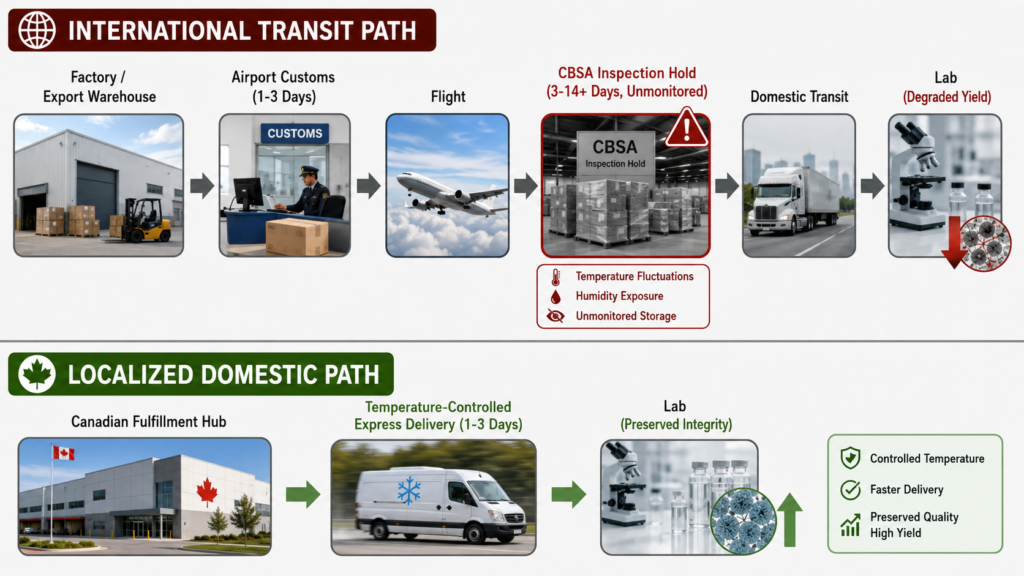
International Transit Path vs. Localized Domestic Path
The Risk of Unmonitored Border Clearance Holds
International parcels containing lyophilized research powders are routinely flagged for manual clearance, documentation verification, or tariff categorization. A package subjected to CBSA customs delays can sit in a transit warehouse for days or weeks without thermal regulation. Experiencing prolonged research chemicals border clearance holds leaves temperature-sensitive compounds exposed to heat waves or sub-zero freezing cycles, driving non-enzymatic degradation before receipt.
In a published logistical analysis, NCBI researchers documented that unmonitored ambient temperature fluctuations during transport significantly accelerate active reagent breakdown in non-refrigerated cargo holds. Furthermore, international purchasing exposes institutional budgets to unpredictable import tariffs, currency conversion fees, and administrative overhead.
Key Advantages of Localized Domestic Shipping
Transitioning to localized fulfillment eliminates the unpredictable variables of border crossings and extended cargo handling. Sourcing through a provider utilizing localized Canadian domestic shipping provides significant operational advantages for Canadian facilities:
| Operational Metric | International Sourcing | Localized Canadian Fulfillment |
| Transit Duration | 7 to 21+ Business Days | 1 to 3 Business Days |
| Customs Inspection | Subject to CBSA holds and seizures | Zero border checks or customs holds |
| Cold-Chain Maintenance | Frequently compromised during customs delays | Fully maintained via short express routes |
| Purity Guarantee upon Receipt | Risk of partial thermal breakdown | High analytical integrity (>99% via HPLC) |
| Financial Overhead | Surcharges, duties, FX conversion fees | Transparent, predictable domestic pricing |
Preserving High Purity Standards and Protocol Continuity
When laboratories receive compounds that have undergone thermal breakdown, experimental data becomes unreliable. Sourcing through domestic suppliers that provide batch-specific HPLC purity verification ensures that compounds maintain greater than 99% purity upon arrival.
Fast domestic reorder windows also allow research teams to run synchronized assay schedules without maintaining excessive inventory in facility freezers, preserving long-term stability.

Frequently Asked Questions
Q1: Why do customs delays increase the risk of peptide degradation?
Direct Answer: Customs holds expose shipments to unmonitored ambient environments for extended durations, triggering thermal and chemical breakdown pathways before delivery.
- Mechanism: Thermal stress accelerates non-enzymatic deamidation and peptide backbone hydrolysis.
- Impact: Misfolding and cleavage reduce functional concentration and lower assay reproducibility.
- Solution: Domestic shipping bypasses border checkpoints, ensuring delivery within 1 to 3 business days.
Q2: How does localized domestic shipping protect peptide structural integrity during transit?
Direct Answer: Express domestic transit shortens total time in transit and enables consistent cold-chain packaging performance from dispatch to receipt.
- Minimized Exposure: Reducing transit time from weeks to 1–3 days limits exposure to ambient fluctuations.
- Packaging Efficiency: Short shipping durations ensure phase-change gel packs remain at target temperatures.
- Vibration Reduction: Fewer handling steps reduce mechanical shock, preventing physical peptide aggregation.
Q3: How do domestic suppliers verify high peptide purity for Canadian laboratories?
Direct Answer: Reputable domestic suppliers validate every batch using High-Performance Liquid Chromatography (HPLC) and Mass Spectrometry (MS) analysis.
- Chromatographic Purity: HPLC confirms chemical purity levels, ensuring compounds meet >99% standards.
- Mass Verification: Mass spectrometry verifies exact molecular mass and amino acid sequence fidelity.
- Documentation Access: Researchers can easily contact our support team for COA documentation prior to protocol initiation.

Q4: Why is lyophilized peptide stability affected by ambient temperature changes in transit?
Direct Answer: While lyophilization removes liquid water, residual moisture and ambient heat can still trigger slow degradation cascades over time.
- Residual Hydrolysis: Trace moisture inside vials reacts with peptide bonds when thermal energy increases.
- Side-Chain Oxidation: Temperature increases accelerate oxidation rate constants for methionine and cysteine.
- Cake Collapse: High heat can cause the lyophilized cake structure to collapse, reducing solubility upon reconstitution.
Q5: How does sourcing domestic peptides improve preclinical research reproducibility?
Direct Answer: Domestic fulfillment eliminates transit-induced degradation variables and supply chain delays, ensuring consistent molar potency across recurring assay trials.
- Batch-to-Batch Consistency: Preventing non-enzymatic breakdown during transit eliminates baseline artifacts in cell culture models and receptor binding assays.
- Synchronized Workflow: Rapid domestic transit allows principal investigators to align compound arrival directly with time-sensitive cell culture and animal tissue protocols.
- Receptor Specificity: Eliminating degraded peptide fragments prevents non-specific competitive inhibition in high-scrutiny target studies, such as multi-agonist GLP-1, GIP, and glucagon receptor research.
Q6: How can Canadian researchers verify the analytical quality of domestically shipped peptides?
Direct Answer: Academic and preclinical researchers can verify compound authenticity by obtaining batch-specific Certificate of Analysis (COA) documentation directly from the domestic provider prior to assay setup.
- Chromatographic Purity: High-Performance Liquid Chromatography (HPLC) chromatograms confirm exact purity percentages (>99%) and verify the absence of residual manufacturing byproducts.
- Sequence Fidelity: Mass spectrometry (MS) spectra confirm theoretical molecular mass and validate correct amino acid sequence synthesis.
- Analytical Documentation: Researchers can contact our support team for COA documentation or consult Canadian research chemical standards to validate analytical metrics prior to initiating solvent reconstitution protocols.

Localized Logistics as a Core Quality Control Standard
In modern preclinical and molecular biology research, supply chain speed and environmental control are as fundamental to scientific integrity as analytical testing and laboratory protocols. Relying on international fulfillment routes exposes delicate lyophilized peptide matrices to unmonitored ambient temperatures, mechanical agitation, and prolonged customs holds. These physical and chemical stress factors accelerate deamidation, oxidation, and structural cleavage, introducing confounding variables that undermine experimental reproducibility and invalidate costly research data.
Transitioning to localized fulfillment networks removes these environmental vulnerabilities from the experimental workflow. By establishing short, temperature-controlled transit routes within domestic borders, Canadian research institutions protect their financial investments, eliminate international border uncertainties, and guarantee that biological reagents arrive with their primary covalent structures intact. Prioritizing providers that align with established Canadian research chemical standards ensures that high-purity compounds retain their structural fidelity from dispatch to benchtop reconstitution.
Ultimately, integrating localized logistics into standard procurement practices empowers principal investigators and facility managers to safeguard experimental rigor. Mitigating kinetic breakdown pathways before compounds ever reach the lab bench ensures consistent molar potency, enhances assay accuracy, and continues to drive meaningful scientific discovery across Canadian research institutions.
Ready to Advance Your Research?
Browse our catalog of verified research peptides, sourced and shipped exclusively within Canada. COAs available on request.
Disclaimer: All Peptide Wave products are intended strictly for laboratory research use only. Not approved for, nor intended for, human or veterinary consumption.