In modern molecular biology, laboratory assay configuration, and preclinical gerontology, a primary objective is identifying precise mechanisms that restore cellular homeostatic equilibrium. For decades, conventional pharmacology has predominantly focused on high-affinity, single-receptor agonist or antagonist ligands designed to forcibly activate or block surface-level signaling pathways. However, the pioneering research originating from the St. Petersburg Institute of Bioregulation and Gerontology introduced an entirely distinct biological paradigm centered on direct genomic regulation.
Led by the late Professor Vladimir Khavinson, whose foundational research on peptide bioregulation began in the 1970s, over five decades of rigorous preclinical bioregulator research revealed that ultra-short amino acid sequences, comprising just 2 to 4 amino acids, act as targeted, epigenetic gene expression regulators. Rather than flooding single membrane-bound receptor pathways, these Khavinson peptide bioregulators cross nuclear barriers to interact directly with chromatin structures, unpacking condensed DNA regions and recalibrating protein synthesis.
Crucially, Khavinson’s extensive longitudinal data demonstrated that while single-peptide monotherapies yield measurable, tissue-specific cellular improvements, multi-peptide protocol synergy delivers exponentially greater biological stability, systemic resistance to metabolic stress, and profound longitudinal survival outcomes.

The Discovery of Short-Chain Peptide Bioregulators
For much of the 20th century, classical peptide research concentrated on larger polypeptide hormones and growth factors, such as insulin or growth hormone. These molecules possess complex tertiary structures designed to bind membrane-bound receptors on the extracellular surface, initiating intracellular secondary messenger cascades (such as cAMP or MAPK signaling pathways). While effective for rapid physiological signaling, this receptor-mediated approach frequently leads to receptor desensitization, down-regulation, or tachyphylaxis when target tissues are exposed to sustained concentrations.
In contrast, Khavinson’s team uncovered a class of low-molecular-weight peptide complexes capable of entirely bypassing traditional membrane-bound signal transduction pathways. These tissue-specific short peptides, typically di-peptides, tri-peptides, or tetra-peptides, possess specific charge distributions and physical dimensions that allow them to penetrate both cellular and nuclear membranes via simple diffusion or specialized transport channels.
Once inside the cell nucleus, these short-chain amino acid sequences do not act as classical metabolic substrates; instead, they participate directly in epigenetic gene expression regulation. By physically interacting with DNA histones and promoter regions of specific genes, these short-chain peptides restore transcription rates that typically decline due to cellular aging, oxidative damage, or environmental stress. This breakthrough shifted the fundamental understanding of peptide dynamics from superficial

Dr. Vladimir Khavinson & The Origin of Cytomedines
The foundation of bioregulatory peptide science is intrinsically linked to Professor Vladimir Khavinson (1946-2024), former President of the European Region of the International Association of Gerontology and Geriatrics (IAGG) and Member of the Russian Academy of Sciences.
Dr. Khavinson’s research journey began in the 1970s at the Military Medical Academy in Leningrad. Commissioned to develop medical countermeasures for military personnel exposed to severe environmental hazards, including ionising radiation, toxic exposure, extreme thermal stress, and acute physical exhaustion, Khavinson and his colleague, Vyacheslav Morozov, sought biological agents capable of rapidly restoring organ tissue integrity and immune function.
The Evolutionary Timeline of Peptide Discovery:
- 1970s to 1980s (First-Generation Organ Extracts): Khavinson’s foundational work began with crude low-molecular-weight peptide extracts isolated from animal tissues, termed cytomedines (and later cytomaxes).
- 1980s to 1990s (Synthetic Cytogens): Through advanced sequencing, Khavinson mapped the precise active short-chain amino acid sequences responsible for tissue regeneration, leading to bio-identical synthetic peptides (cytogens) that allowed for exact, reproducible assays.
- Post-1990s (Second-Generation Organ-Specific Synthetics): Expansion into a comprehensive library of synthetic short peptides targeting additional specific tissue systems.
Comprehensive Profile of Khavinson Peptides: Development & Tissue Specificity
Understanding the historical timeline of Dr. Khavinson’s discoveries provides key insight into how long peptide research has been unfolding. Below is the complete list of peptides discovered and synthesized by Dr. Khavinson, spanning early natural tissue extracts to late-generation synthetic short-chain peptides.
Dr. Vladimir Khavinson Peptide Bioregulator Summary
| Peptide Name | Sequence / Type | Target Tissue / Function | Timeline / Development Era |
| Thymalin | Natural organ extract complex | Thymus gland extract for cellular immune restoration | 1970s to 1980s (First organ-extract series) |
| Epithalamin | Natural organ extract complex | Pineal gland extract for neuroendocrine and circadian regulation | 1980s |
| Cortexin | Natural organ extract complex | Cerebral cortex extract for central nervous system support | 1980s to 1990s |
| Prostatilen | Natural organ extract complex | Prostate extract for male reproductive and urological health | 1980s to 1990s |
| Retinalamin | Natural organ extract complex | Retina extract for ocular tissue maintenance | 1980s to 1990s |
| Epitalon (Epithalon) | Synthetic tetrapeptide (Ala-Glu-Asp-Gly) | Pineal analog for telomerase activation and neuroendocrine modulation | Synthesized 1980s (Approved 1990) |
| Vilon | Synthetic dipeptide (Lys-Glu) | Thymic analog for rapid T-cell gene activation and immune support | Later synthetic series (Post-1990s) |
| Cortagen | Synthetic tetrapeptide (Ala-Glu-Asp-Pro) | Adrenal cortex analog for stress response normalization | Later synthetic series (Post-1990s) |
| Thymogen | Synthetic dipeptide (Glu-Trp) | Immunomodulatory dipeptide for immune response regulation | Later synthetic series (Post-1990s) |
| Pinealon | Synthetic short peptide | Brain and central nervous system bioregulation | Post-1990s second generation |
| Vesugen | Synthetic short peptide | Vascular and endothelial tissue regulation | Post-1990s second generation |
| Bronchogen | Synthetic tetrapeptide (Ala-Asp-Glu-Leu) | Respiratory tissue bioregulation and bronchial epithelial integrity | Post-1990s second generation |
| Cardiogen | Synthetic short peptide | Myocardial tissue regulation and cardiac homeostasis | Post-1990s second generation |
| Livagen | Synthetic tetrapeptide (Lys-Glu-Asp-Ala) | Hepatic bioregulator for liver cell chromatin activation | Post-1990s second generation |
The Epigenetic Mechanism: Direct DNA Binding & Chromatin Remodeling
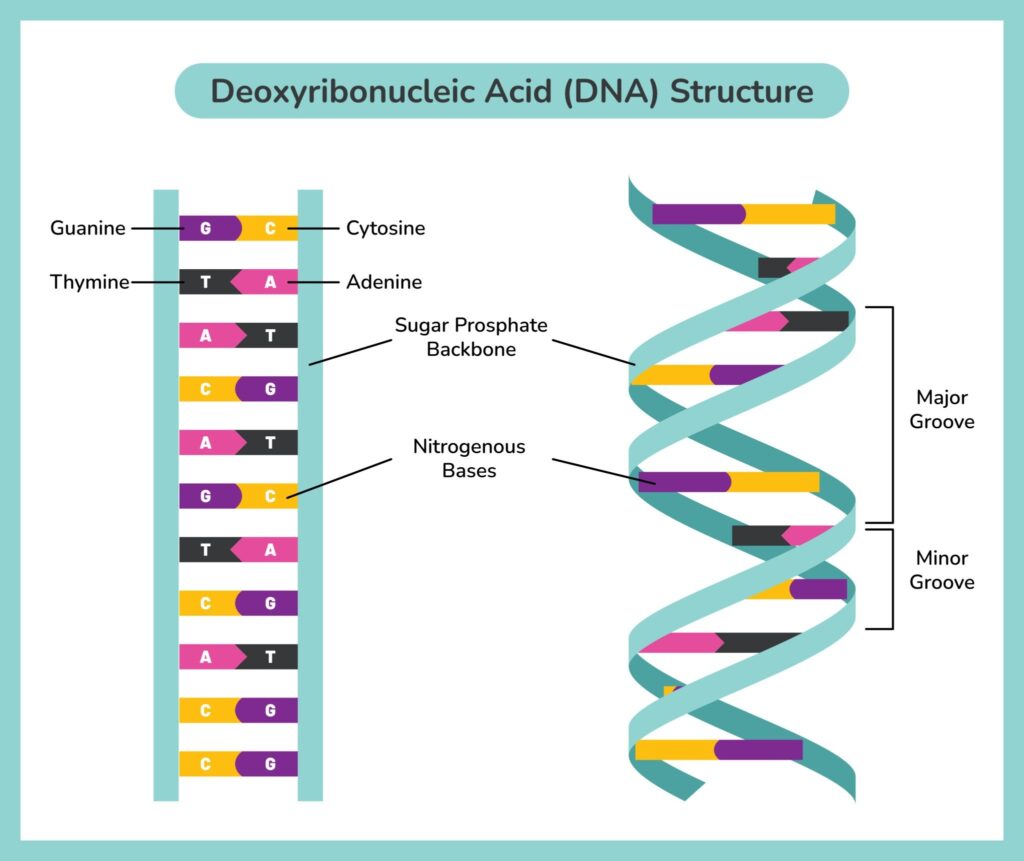
The central question in Khavinsonian science was biophysical: how can a simple di-peptide or tetra-peptide induce highly specific changes in genomic transcription without complex protein machinery? The answer lies in the atomic-scale stereospecific interaction between amino acid side chains and the double-helix geometry of DNA.
In differentiated somatic cells, particularly as they undergo senescence or experience severe stress, large regions of genomic DNA become densely packaged into condensed, transcriptionally silent structures known as heterochromatin. In this state, core histone proteins bind tightly to the DNA backbone, physically blocking RNA polymerase enzymes and transcription factors from accessing gene promoter regions. This progressive heterochromatinization leads to reduced protein synthesis, cellular senescence, and eventual functional failure.
Through nuclear magnetic resonance (NMR) spectroscopy, circular dichroism, and molecular dynamics modeling, Khavinson’s team mapped out the direct DNA binding mechanism:
- Groove Geometry Recognition: Short-chain amino acid sequences possess precise hydrogen-bonding donor and acceptor patterns and charge distributions that perfectly match the spatial topography of the major and minor grooves in double-stranded DNA.
- Sequence-Specific Binding: Di- and tetra-peptides bind complementary nucleotide base pairs (such as specific AT- or GC-rich sequences) within the promoter regions of target genes. For example, Epitalon binds specifically to promoter regions governing telomerase reverse transcriptase (TERT) expression.
- Histone Displacement & Decondensation: The spatial insertion of the peptide into the DNA groove alters the local electrostatic charge density along the phosphate backbone. This triggers a heterochromatin decondensation assay response, loosening the histone-DNA complex and causing condensed heterochromatin to unfold into active, accessible euchromatin.
- Transcriptional Reactivation: With the promoter region exposed, endogenous RNA polymerase binds unhindered, restoring mRNA transcription and protein synthesis back to youthful homeostatic baselines.
Monotherapy vs. Multi-Peptide Protocols: The Synergistic Advantage
While administering a single short peptide (monotherapy) can effectively reactivate a specific organ pathway, biological organisms are complex, multi-layered physiological networks. No organ or cellular system operates in complete isolation; every tissue relies on continuous, reciprocal feedback from endocrine, immune, and vascular networks.
The Functional Limits of Monotherapy
When an organism undergoes multi-system decline due to age or disease, restoring a single pathway creates a physiological mismatch. For instance, using Epitalon alone to restore pineal melatonin synthesis and neuroendocrine signaling yields clear localized benefits. However, if the immune system (thymus) remains severely compromised or the liver (hepatic metabolic clearance) cannot clear systemic inflammatory byproducts, the overall therapeutic ceiling of the intervention is strictly capped.
The Power of Multi-Peptide Protocol Synergy
A synergistic multi-peptide assay design targets multiple regulatory nodes along interconnected biological axes simultaneously. By synchronizing gene activation across complementary organ systems, multi-peptide protocols eliminate single-system bottlenecks, producing cascading homeostatic feedback loops:
- The Neuroendocrine-Immune Axis (Epitalon + Vilon): Combining pineal bioregulation (Epitalon) with thymic bioregulation (Vilon) simultaneously optimizes neuroendocrine signaling and T-cell-mediated immune surveillance. Elevated melatonin levels enhance thymic weight and lymphocyte production, while restored T-cell signaling reduces systemic inflammatory cytokines that would otherwise suppress pineal function.
- The Metabolic-Clearance Axis (Epitalon + Livagen + Pancragen): Combining pineal regulation with hepatic and pancreatic bioregulators simultaneously optimizes circadian metabolic rhythms, liver detoxification pathways, and pancreatic glucose tolerance, providing total cellular energy protection under metabolic stress conditions.
By addressing the master regulatory networks simultaneously, multi-peptide protocols yield systemic cellular recalibration that far surpasses the additive effects of each individual peptide administered alone.

Longitudinal Data & Preclinical Survival Studies
The theoretical framework of multi-peptide synergy is substantiated by decades of empirical research. Over a 30-year timeframe, the St. Petersburg Institute of Bioregulation and Gerontology conducted landmark longitudinal preclinical trials across diverse animal models (including short-lived rodents like Mice and Rattus norvegicus, canine models, and non-human primates like Macaca mulatta), as well as long-term clinical cohorts published in international journals such as the Bulletin of Experimental Biology and Medicine and Biogerontology.
Summary of Longitudinal Research Findings:
| Preclinical Protocol Model | Primary Biological Mechanism | Impact on Longitudinal Survival Curves |
| Control Arm (Placebo) | Progressive heterochromatin accumulation, decline in protein synthesis, age-related tissue atrophy | Standard baseline mortality curve; expected median lifespan baseline |
| Single-Peptide Monotherapy (e.g., Epitalon alone) | Organ-specific chromatin decondensation, localized restoration of target tissue protein synthesis | 12% to 18% increase in median lifespan; moderate reduction in spontaneous tissue lesion formation |
| Multi-Peptide Protocol (e.g., Epitalon + Thymus Bioregulator) | Simultaneous neuroendocrine and immune axis recalibration; marked decrease in systemic inflammatory markers and tumor incidence | 30% to 42% increase in median lifespan; significant right-ward shift and flattening of survival curves |
The longitudinal survival curves demonstrate a striking biological truth: while monotherapies offer modest life-extension benefits, multi-peptide combination protocols drastically alter mortality kinetics. The combination of pineal and thymic bioregulators achieved unprecedented reductions in spontaneous tumor development (up to a 50% drop in rodent models) while maintaining structural tissue integrity into late-stage lifespan windows.
Modern Implications for Preclinical Protocol Design
Starting in the early 1970s at the Military Medical Academy in Leningrad, Professor Vladimir Khavinson began a monumental body of research spanning over 50 years that fundamentally altered how molecular biologists view peptide interactions. By demonstrating that short-chain amino acid sequences function as direct, sequence-specific epigenetic switches, his multi-decade work established a firm scientific foundation for molecular gerontology.
For contemporary laboratory researchers, biochemists, and assay designers configuring preclinical bioregulator research models, the broader implications are unambiguous: single-target interventions are inherently limited when dealing with complex, multi-system biological decline. Moving beyond high-dose receptor saturation toward synergistic multi-peptide assay design allows researchers to tap into natural, complementary gene activation networks, unlocking superior tissue recalibration, complete homeostatic restoration, and optimal long-term functional survival.
Ready to Advance Your Research?
Browse our catalog of verified research peptides, sourced and shipped exclusively within Canada. COAs available on request.
Disclaimer: All Peptide Wave products are intended strictly for laboratory research use only. Not approved for, nor intended for, human or veterinary consumption.