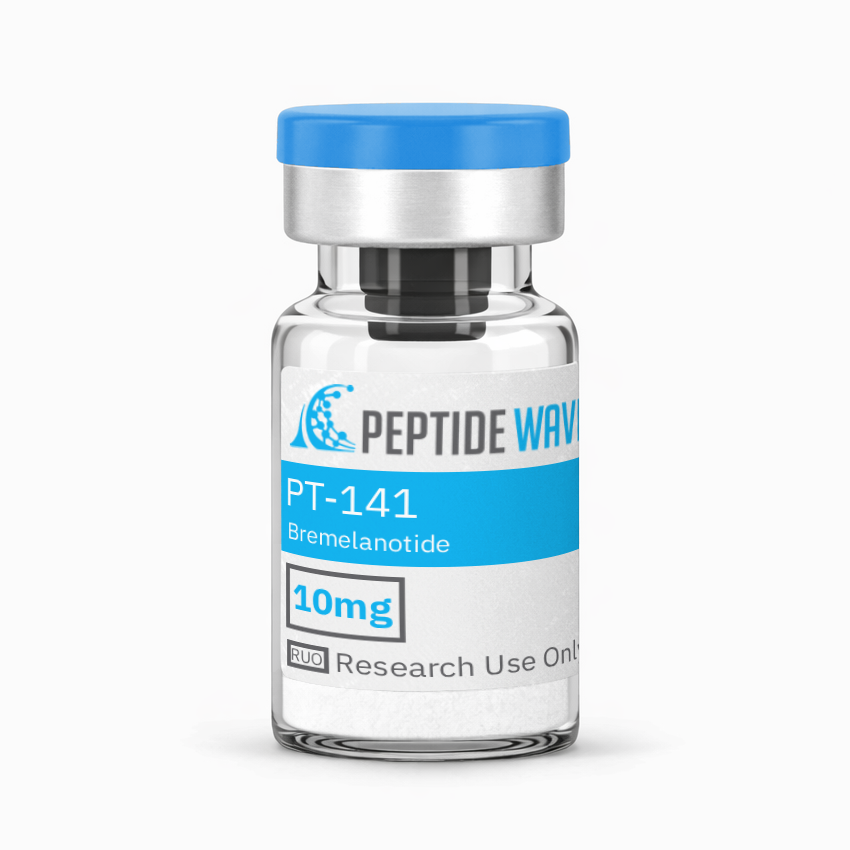
CAS Number: 189691-06-3
Molecular Formula: C₅₀H₆₈N₁₄O₁₀
Molecular Weight: 1025.17 g/mol
Sequence: Ac-Nle-cyclo[Asp-His-D-Phe-Arg-Trp-Lys]-OH (7 amino acids, cyclic)
What Is PT-141?
PT-141, known generically as bremelanotide, is a synthetic peptide drug and the first of a new class: melanocortin receptor agonists. It was derived from research on melanotan II — a peptide initially developed for sunless tanning that unexpectedly induced sexual arousal and erections in early tests. Intricateartseminars PT-141 is an agonist at melanocortin receptors including MC3R and MC4R, which are expressed primarily in the central nervous system. Alzdiscovery Unlike traditional sexual dysfunction treatments, PT-141 affects the nervous system, so it not only increases blood flow to the sex organs but also helps increase sexual desire. PubMed Central
PT-141 is essentially a brain-based libido switch.
Most sexual dysfunction drugs like Viagra work below the belt — they relax blood vessels to improve blood flow. That’s purely mechanical. If the desire isn’t there, Viagra doesn’t help with that.
PT-141 works differently. It goes to your brain and taps into the system that controls sexual desire and motivation — the same reward pathways that dopamine flows through. It basically signals your brain: “you want this.” The physical response (arousal, erection, lubrication) follows naturally from that brain signal, the same way it would naturally.
Think of it like this:
Viagra = turns up the volume on the speakers, but someone still has to press play. PT-141 = presses play.
That’s also why it’s the only drug FDA-approved to treat low sexual desire in women — because desire is a brain problem, not a plumbing problem, and PT-141 is the only one working at that level.
The tradeoff is that because it’s acting on the brain and nervous system rather than just blood vessels, side effects are more systemic — nausea, flushing, temporary blood pressure changes, and sometimes skin darkening are the most common.
In short: PT-141 treats the “want to,” not just the “able to.”
Health Benefits Being Researched
1. Female Hypoactive Sexual Desire Disorder (HSDD) — FDA Approved
Bremelanotide was approved for medical use in the United States in 2019, and the FDA considers it to be a first-in-class medication. It is used for the treatment of generalized hypoactive sexual desire disorder (HSDD) in premenopausal women. Innerbody Across multiple controlled clinical trials, bremelanotide has been demonstrated to be a possible treatment option for women with HSDD. Frontiers
2. Erectile Dysfunction in Men (Off-Label)
Administration of PT-141 to normal men and to patients with erectile dysfunction resulted in a rapid dose-dependent increase in erectile activity, suggesting it holds promise as a new treatment for sexual dysfunction. Alzdiscovery Research also suggests that PT-141 can work synergistically with traditional ED medications — a study found that the combination of bremelanotide and sildenafil in men who were inadequately responsive to sildenafil alone induced a clinically significant enhanced erectile response. PubMed Central
3. Sexual Arousal & Desire in Both Sexes
Both melanotan-II and bremelanotide have been reported to stimulate both sexual arousal and desire in humans and rats following intranasal, intravenous, and subcutaneous administration. In women, they increase measures of sexual desire, including subjective measures of desire. PubMed Central
4. Mood & Psychological Well-being
PT-141 can help improve sexual performance and elevate mood. Addressing psychological factors such as stress or anxiety that may contribute to erectile dysfunction may also enhance overall well-being, mood, energy, and fitness levels. PubMed Central
5. Incidental Finding — Weight & Appetite
An analysis of clinical trials found that obese women reduced their calorie intake and lost weight Innerbody while using bremelanotide, suggesting a potential secondary metabolic benefit worth further investigation.
The Melanocortin Receptor System
The melanocortin system comprises five G protein-coupled receptors (MC1R–MC5R) with distinct anatomical distributions and functional roles. PT-141 demonstrates activity at multiple melanocortin receptor subtypes but is primarily studied for its effects mediated through MC3R and MC4R — the receptor subtypes most highly expressed in the hypothalamus and limbic system. Innerbody
Here’s what each receptor does:
- MC1R — controls skin pigmentation, activating melanocytes, which explains one side effect of PT-141: transient skin darkening or freckling in some individuals. PubMed Central
- MC3R — may contribute to the motivational components of sexual arousal — the desire rather than merely the physiological response. This receptor sits at the intersection of energy regulation and reward pathways. Innerbody
- MC4R — MC4R knockout mice show markedly impaired erectile function in males and reduced sexual receptivity in females, establishing this receptor as a key mediator of centrally regulated sexual arousal. Innerbody
- MC3R & MC4R together — are found in the hypothalamus and are involved in food intake and energy homeostasis Alzdiscovery, which also explains the observed appetite-suppression side effect in some users.
Step-by-Step: How PT-141 Works
Step 1 — Central Nervous System Entry
Unlike phosphodiesterase-5 (PDE5) inhibitors, which achieve their effects through peripheral vascular mechanisms, PT-141 operates centrally through the activation of MC3R and MC4R receptors in the central nervous system — specifically in hypothalamic and limbic regions associated with sexual arousal and motivation. Innerbody
Step 2 — Hypothalamic Activation
Systemic administration of PT-141 activates neurons in the hypothalamus, as shown by an increase in c-Fos immunoreactivity — a marker of neuronal activation. Neurons in the same region of the central nervous system connect directly to the corpus cavernosum of the penis PubMed Central, demonstrating a direct neural chain from brain to genitalia.
Step 3 — Dopamine Release
Activation of MC4 receptors by PT-141 is thought to increase the release of dopamine in the medial preoptic area of the hypothalamus — a region that governs sexual desire and arousal. PubMed Central This is why PT-141 addresses desire and motivation, not just physical response.
Step 4 — Downstream Neural Signaling
PT-141 stimulates the paraventricular nucleus (PVN) neurons involved in sexual behavior, enhances oxytocin and dopamine release in reward pathways, modulates hypothalamic-pituitary-gonadal axis activity, and activates descending pathways to sexual response centers. Nature
Step 5 — Peripheral Physical Response
MC4 activation in the brain leads to neuronal signals down the spinal cord to the pelvic organs, resulting in penile erection via increased parasympathetic activity. Importantly, bremelanotide’s mechanism does not rely on nitric oxide, so it can work even when nitric oxide pathways — targeted by Viagra and similar drugs — are insufficient. PubMed Central
How It Differs From Viagra/Cialis (PDE5 Inhibitors)
| Feature | PT-141 | Viagra/Cialis |
|---|---|---|
| Where it acts | Brain (CNS) | Blood vessels (peripheral) |
| What it targets | MC3R/MC4R receptors | PDE5 enzyme |
| Addresses desire? | ✅ Yes | ❌ No |
| Requires arousal to work? | Less dependent | Yes |
| Works without nitric oxide? | ✅ Yes | ❌ No |
| FDA approved for women? | ✅ Yes (HSDD) | ❌ No |
In summary, PT-141’s mechanism can be thought of as “flipping the switch” in the brain that turns on sexual desire and erection signals — rather than simply enhancing the plumbing once that switch has already been flipped. PubMed Central
Pharmacokinetics (How It Moves Through the Body)
The bioavailability of bremelanotide with subcutaneous injection is about 100%. Following injection, maximal blood levels occur after about one hour. The plasma protein binding is 21%, and the elimination half-life is 2.7 hours. Bremelanotide is metabolized via hydrolysis of its peptide bonds and is excreted 64.8% in urine and 22.8% in feces. PubMed Central
For intranasal (compounded) formulations: this method bypasses hepatic first-pass metabolism, rapidly crossing the blood-brain barrier and initiating a faster onset of action, typically within 30–60 minutes prior to anticipated sexual activity. Frontiers
Key Side Effects & Contraindications
The most frequently encountered side effect is nausea (40%), followed by flushing (20.3%), injection site reactions (13.2%), headache (11.3%), vomiting (4.8%), fatigue (3.2%), and hot flashes (2.7%). Discoloration of the skin — specifically hyperpigmentation — may occur, especially if used more than eight times per month, and may not resolve upon stopping use. PubMed Central
Due to its effects on blood pressure — generally a transient increase of 6 mmHg systolic and 3 mmHg diastolic — bremelanotide is contraindicated in people with uncontrolled high blood pressure or cardiovascular disease. PubMed Central
![TB-500 [TB4] (10mg)](https://peptidewave.com/wp-content/uploads/2026/01/wavetides-peptide-wave-best-peptides-in-canada-TB-500-Thymosin-Beta-4-43aa-10mg-300x300.png)
Reviews
There are no reviews yet.