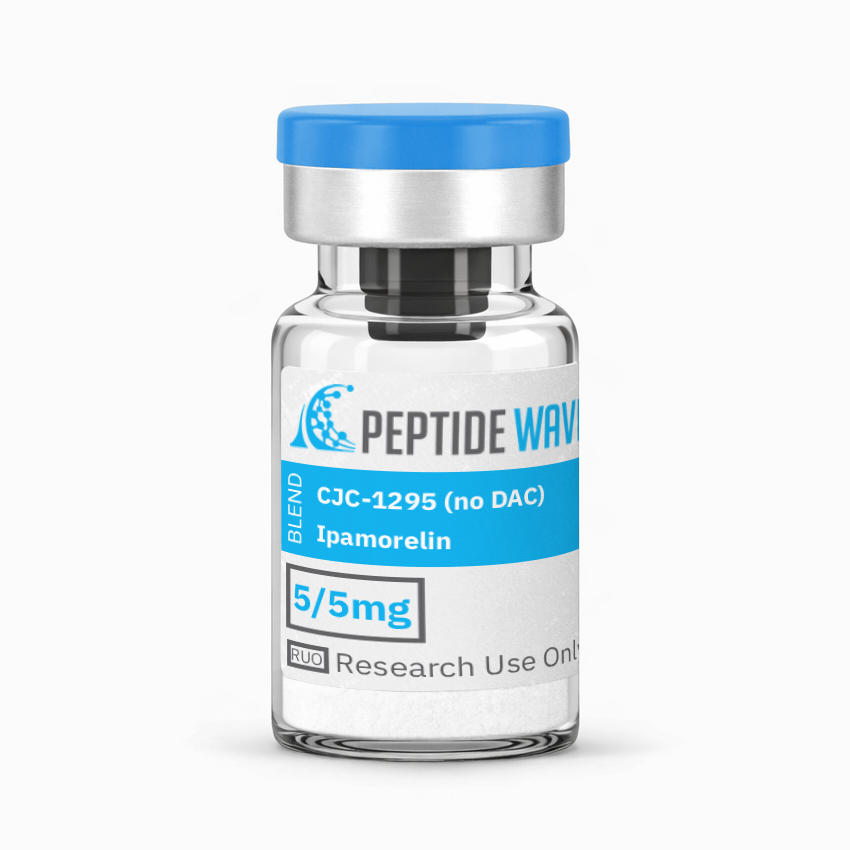
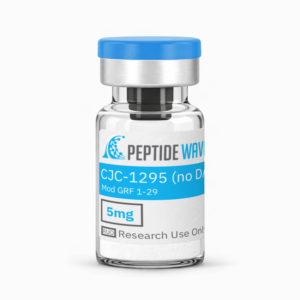
CJC-1295 + Ipamorelin (Blend)
(GHRH analogue + GHRP combined — not a single molecule)
| Property | CJC-1295 (no DAC) | Ipamorelin |
|---|---|---|
| CAS # | 446036-97-1 | 170851-70-4 |
| Molecular Formula | C₁₅₂H₂₅₂N₄₄O₄₂ | C₃₈H₄₉N₉O₅ |
| Molecular Weight | 3,367.9 g/mol | 711.87 g/mol |
| Amino Acid Sequence | Tyr-D-Ala-Asp-Ala-Ile-Phe-Thr-Gln-Ser-Tyr-Arg-Lys-Val-Leu-Ala-Gln-Leu-Ser-Ala-Arg-Lys-Leu-Leu-Gln-Asp-Ile-Met-Ser-Arg (29 AAs, modified) | Aib-His-D-2-Nal-D-Phe-Lys-NH₂ |
| Chain Length | 29 amino acids | 5 amino acids (pentapeptide) |
Note: CJC-1295 + Ipamorelin is a compounded blend of two synergistic peptides — a GHRH analogue (CJC-1295) paired with a GHRP (Ipamorelin). It has no single CAS number or molecular formula. They are commonly blended in a 1:1 to 2:1 molar ratio and act on complementary receptors to amplify GH pulse release.
The big picture first
Your body produces growth hormone (GH) in bursts — mainly during deep sleep — under the control of a delicate push-pull system in the brain. Two signals govern this: one that says “release GH now” (GHRH) and one that says “hold off” (somatostatin). CJC-1295 and Ipamorelin each tap into this system through completely different receptors and different molecular pathways. That’s the foundation of why they work so well together.
CJC-1295 — the “raise the ceiling” signal
GHRH is a 44-amino acid peptide synthesized in the hypothalamus that binds to receptors on pituitary somatotropes to promote synthesis and release of GH. MuseChem CJC-1295 without DAC is a synthetic, modified version of that signal — built to last far longer in the body than natural GHRH, which breaks down within minutes.
What it does at the receptor level:
CJC-1295 selectively binds to and activates GHRH receptors on anterior pituitary somatotrophs, leading to enhanced adenylyl cyclase activation and cyclic AMP (cAMP) production, increased protein kinase A (PKA) phosphorylation cascades, and stimulation of growth hormone gene transcription and protein synthesis — producing pulsatile GH release that mimics natural physiological patterns. InvivoChem
In plain terms: CJC-1295 walks up to the GHRH receptor on the pituitary gland, knocks on the door, and the pituitary responds by manufacturing and releasing GH. It works through the cAMP → PKA signaling cascade — think of this as the “accelerator pedal” for GH production.
What makes it unique — the albumin binding:
The extended half-life of CJC-1295 (8–10 days in humans) is due to its ability to bind to endogenous serum albumin through a free thiol group, forming a covalent bond. CymitQuimica Natural GHRH lasts only a few minutes before enzymes break it down. CJC-1295 essentially hitchhikes on albumin — the most abundant protein in your blood — to survive for days instead.
What the research showed:
After a single injection of CJC-1295, there were dose-dependent increases in mean plasma GH concentrations by 2- to 10-fold for 6 days or more, and in mean plasma IGF-1 concentrations by 1.5- to 3-fold for 9–11 days. After multiple doses, mean IGF-1 levels remained above baseline for up to 28 days. PubChem
Crucially, CJC-1295 increased trough and mean GH secretion and IGF-1 production with preserved GH pulsatility — the natural rhythm of GH release was maintained, not flattened into a continuous drip. MedKoo
Ipamorelin — the “push the button” signal
Where CJC-1295 mimics GHRH, Ipamorelin mimics an entirely different hormone: ghrelin — the hunger-and-growth signal produced in your stomach. It is a GHRP (Growth Hormone Releasing Peptide), not a GHRH analogue. Completely different receptor, completely different intracellular pathway.
What it does at the receptor level:
By mimicking ghrelin, ipamorelin selectively binds the GHSR-1a receptor (the ghrelin receptor). This interaction with GHSR-1a leads to GH release from the pituitary gland, influencing anabolic processes including appetite regulation, fat processing, and overall energy usage. NYMD
Ipamorelin selectively binds to and activates GHSR-1a receptors, leading to enhanced cyclic adenosine monophosphate (cAMP) production, stimulation of GHRH neurons, and direct pituitary somatotroph cell activation — promoting pulsatile GH secretion that mimics natural circadian rhythms. Oasishealthandmedicine
What makes it uniquely valuable — exceptional selectivity:
The specificity for GH release was studied in swine. None of the GH secretagogues tested affected FSH, LH, prolactin, or TSH plasma levels. Administration of both GHRP-6 and GHRP-2 resulted in increased plasma levels of ACTH and cortisol. Very surprisingly, ipamorelin did not release ACTH or cortisol in levels significantly different from those observed following GHRH stimulation — even at doses more than 200-fold higher than the ED50 for GH release. BodySpec
This is a major distinction. Other GHRPs like GHRP-6 come with unwanted side effects — hunger, cortisol spikes, and prolactin elevation. Ipamorelin is the first GHRP-receptor agonist with a selectivity for GH release similar to that displayed by GHRH itself. VitaLibrary
Why they are synergistic together
The combination is more than additive — it works from two completely independent angles on the same pituitary somatotroph cell simultaneously.
1. Two different receptors, two different intracellular signals.
GHRH analogs work through GHRHR → cAMP/PKA, providing relatively “physiologic” pituitary stimulation with minimal peripheral effects. GHRPs and ghrelin mimetics work through GHSR → calcium/PKC, with a broader tissue distribution. Stacking GHRH + GHRP produces synergistic GH release by activating both pathways simultaneously — this is well-documented in the scientific literature. Dianarangaves
Think of it this way: CJC-1295 presses the cAMP accelerator. Ipamorelin simultaneously floods the cell with calcium through a separate door. Both signals arrive at the same destination — GH secretion — but they came from completely different directions. The cell responds more powerfully to both signals at once than to either alone.
2. Ipamorelin removes the brake that somatostatin applies.
Somatotrophs in the anterior pituitary gland release GH in a pulsatile fashion under the regulation of two hypothalamic peptides: GHRH, which stimulates GH synthesis and secretion, and somatostatin, which inhibits GH release without affecting GH synthesis. Paragonsportsmedicine CJC-1295 pushes the gas — but somatostatin can still pump the brakes. At the hypothalamic level, GHRPs may enhance GHRH release and/or suppress somatostatin, creating a more permissive environment for the direct pituitary effects of administered GHRH. Dianarangaves Ipamorelin essentially lifts that inhibitory brake, allowing CJC-1295’s signal to land on a pituitary that is no longer being told to hold back.
3. The combination mimics what your body does naturally.
The combination may better mimic the natural situation where endogenous ghrelin rises during fasting and amplifies GHRH-driven GH pulses. The result is enhanced GH pulsatility that neither agent achieves alone. Dianarangaves Natural GH release is driven by exactly this kind of dual-signal event: GHRH pushing from the hypothalamus while ghrelin simultaneously removes somatostatin inhibition. The blend recreates this biological pattern pharmacologically.
4. Ipamorelin’s clean selectivity protects the stack.
Because ipamorelin does not raise cortisol, prolactin, FSH, LH, or TSH — even at very high doses — it allows the combination to produce a large, clean GH pulse without the hormonal noise that older GHRPs like GHRP-6 introduced. CJC-1295 is equally selective by nature of acting on the GHRH receptor. The result is a stack that produces amplified GH and IGF-1 without meaningful off-target hormonal effects.
Side-by-side comparison
| Feature | CJC-1295 (no DAC) | Ipamorelin |
|---|---|---|
| Class | GHRH analogue | Ghrelin mimetic (GHRP) |
| Receptor | GHRHR | GHSR-1a |
| Intracellular pathway | cAMP → PKA | Ca²⁺ → PKC |
| Primary action | Increases GH synthesis + release | Amplifies GH pulse, suppresses somatostatin |
| Effect on cortisol | None | None (uniquely selective) |
| Effect on prolactin | None | None |
| Half-life | ~30 min (without DAC) | ~2 hours |
| GH release pattern | Raises the baseline amplitude | Sharpens and amplifies the pulse |
| IGF-1 elevation | Significant, sustained | Moderate, shorter duration |
What the blend produces downstream
When both are administered together — typically via subcutaneous injection in the evening to align with the natural overnight GH pulse — the amplified GH and IGF-1 levels drive a cascade of downstream effects that neither peptide generates as robustly alone:
Lean body composition:
IGF-1 activates muscle protein synthesis and satellite cell proliferation, supporting lean mass development and preservation.
Fat metabolism:
Growth hormone directly drives lipolysis — the breakdown of stored fat for fuel — particularly from visceral fat depots.
Recovery and tissue repair:
Elevated GH and IGF-1 accelerate collagen synthesis, tendon repair, and connective tissue remodeling.
Sleep quality:
GH secretion and slow-wave (deep) sleep have a bidirectional relationship — amplifying the overnight GH pulse also deepens sleep architecture.
Bone density:
IGF-1 stimulates osteoblast proliferation, supporting bone mineral density over time.
Reviews
There are no reviews yet.